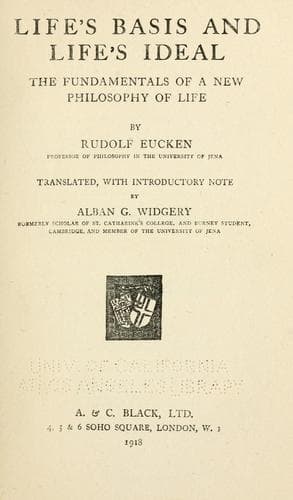
Life's Basis and Life's Ideal: The Fundamentals of a New Philosophy of LifeEucken, Rudolf
Philosophy
Life's Basis and Life's Ideal: The Fundamentals of a New Philosophy of Life
Eucken, Rudolf
Life; Ontology
Such a requirement of life and thought arising out of the immediate
present may easily lead us to separate from those to whom the crisis
does not seem so serious, and who believe that it is possible to
transform the old in a quiet and inhostile manner into the new. The
conflict will be far more acute with those who, with us, make the demand
for an independent present; but who, by the conceptions of an
independent present, freedom and spontaneity, understand something
totally different from that which we ourselves understand by them from
the point of view of an independent spiritual life. In all times of
spiritual revival the freedom and immediacy which the spiritual life
needs for itself have been usurped by mere man as though they were a
right pertaining to him: and then it appears that only the complete
emancipation of individuals, a severance of all connections,
unconditional submission to the passing moment, are necessary in order
to lead life to truth and greatness, and man to a glorious state of
happiness. Such a movement cannot spread without making the antitheses
of life appear less acute, concealing its problems and its depths, and
falsely idealising man with all the contingency of his experience: with
all the bustle of its preparation and all its agitation the movement
must terminate in a state of spiritual destitution; it threatens life
with inner destruction. With a modernity of this kind we have nothing in
common.
We must, therefore, with all our power, wage war against the narrowly
human and imaginary freedom on behalf of one that is genuine and
spiritual: this conflict is exceptionally complicated and difficult,
because real life does not make such a clear distinction between the
genuine and the false as the conceptions do, but rather allows them to
be confused. For this reason the conflict will be carried on not only on
the right hand and on the left, but also against the confusion that
obscures the great "either--or," without the distinct presence of which
a spontaneous life does not acquire power and consciousness. A way must
be found by which, notwithstanding manifold dangers and complications,
we may advance to a life that combines depth with freedom, stability
with movement: this is an inner necessity of the age, and once it is
recognised and taken up as such, it will in some way be realised.
(a) RELIGION, MORALITY, EDUCATION
1. RELIGION
Public-domain text, read in full here on John Shaqi.
Reviews
Reviews
No reviews yet
Be the first to share your thoughts on this work.
Elsewhere in the archive
Join the Discussion
Join the discussion
Sign in to leave a comment or review.
Sign InorCreate an account