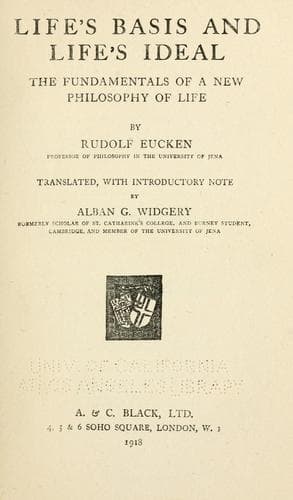
Life's Basis and Life's Ideal: The Fundamentals of a New Philosophy of LifeEucken, Rudolf
Philosophy
Life's Basis and Life's Ideal: The Fundamentals of a New Philosophy of Life
Eucken, Rudolf
Life; Ontology
certainly as humanity confidently maintains that its life has meaning
and value, so certainly will it take up the problem of morality ever
anew against all attempted intimidation.
If to-day we are again to take up this problem, then in the first place
the conditions and the requirements of the problem must be quite clear.
We can never acquire a morality from the troubled confusion of social
life; on the contrary, morality involves a transcendence of this; it
necessitates distinctive convictions concerning the world as a whole and
our position in it. There is no independent morality, no morality in
itself; morality involves a fundamental whole of life, which is
appropriated in it and by this appropriation first attains to
perfection. In contrast to the existing condition of things a new
condition must first be raised in ideas that precede conduct. The new
condition acquires a moral character only through requiring on the one
hand moral freedom as opposed to the mechanism of natural impulse, on
the other a transcendent ideal in opposition to mere self-preservation.
These two together reveal a new order of things distinct from nature;
they must seem impossible from the point of view of the world of sense,
not only freedom with its apparent annulling of all connections, but
also the freeing of conduct from bondage to mere nature. For how would
one conceive an activity that did not tend ultimately to the good of the
agent, and so aid in his self-preservation? Does it not involve a
contradiction for him to exert his power for something alien to himself?
If in the present we feel such problems in the fullness of their force,
and if we must fight for morality as a whole, we must go back to the
foundations of our existence, and seek primarily for a secure position
in contrast with the instability of temporal experiences. In accordance
with the whole course of our investigation, we can find such a position,
and by further development a distinctive morality also, only in an
independent spiritual life, which first conducts the world to
self-consciousness and so to genuine reality. The two requirements
discussed above cause no difficulty from the point of view of an
independent spiritual life. We convinced ourselves in a previous section
of the reality of freedom in the spiritual life; in morality also
conduct can free itself from the natural _ego_ without degenerating into
a state of emptiness, because the spiritual life reveals a new and the
alone genuine self. Thus here activity is not spent upon something alien
to us, something presented to it from outside, but is within our own
being, which here, indeed, includes the whole infinity within it.
Activity in the spiritual life serves true self-preservation, which has
only the name in common with natural self-preservation.
Public-domain text, read in full here on John Shaqi.
Reviews
Reviews
No reviews yet
Be the first to share your thoughts on this work.
Elsewhere in the archive
Join the Discussion
Join the discussion
Sign in to leave a comment or review.
Sign InorCreate an account