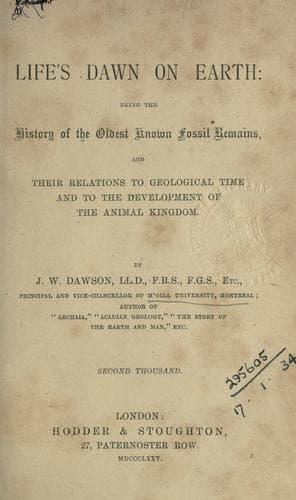
Life's Dawn on Earth: Being the history of the oldest known fossil remains, and their relations to geological time and to the development of the animal kingdomDawson, John William, Sir
History
Life's Dawn on Earth: Being the history of the oldest known fossil remains, and their relations to geological time and to the development of the animal kingdom
Dawson, John William, Sir
Life -- Origin; Paleontology -- Precambrian
The Laurentian rocks, associated with another series only a little
younger, the Huronian, form a great belt of broken and hilly country,
extending from Labrador across the north of Canada to Lake Superior,
and thence bending northward to the Arctic Sea. Everywhere on the lower
St. Lawrence they appear as ranges of billowy rounded ridges on the
north side of the river; and as viewed from the water or the southern
shore, especially when sunset deepens their tints to blue and violet,
they present a grand and massive appearance, which, in the eye of
the geologist, who knows that they have endured the battles and the
storms of time longer than any other mountains, invests them with a
dignity which their mere elevation would fail to give. (Fig. 2.) In the
isolated mass of the Adirondacks, south of the Canadian frontier, they
rise to a still greater elevation, and form an imposing mountain group,
almost equal in height to their somewhat more modern rivals, the White
Mountains, which face them on the opposite side of Lake Champlain.
The grandeur of the old Laurentian ranges is, however, best displayed
where they have been cut across by the great transverse gorge of the
Saguenay, and where the magnificent precipices, known as Capes Trinity
and Eternity, look down from their elevation of 1500 feet on a fiord,
which at their base is more than 100 fathoms deep (see frontispiece).
The name Eternity applied to such a mass is geologically scarcely a
misnomer, for it dates back to the very dawn of geological time, and is
of hoar antiquity in comparison with such upstart ranges as the Andes
and the Alps.
[Illustration: Fig. 2. _Laurentian Hills opposite Kamouraska, Lower St.
Lawrence._
The islands in front are Primordial.]
On a nearer acquaintance, the Laurentian country appears as a broken
and hilly upland and highland district, clad in its pristine state
with magnificent forests, but affording few attractions to the
agriculturist, except in the valleys, which follow the lines of its
softer beds, while it is a favourite region for the angler, the hunter,
and the lumberman. Many of the Laurentian townships of Canada are,
however, already extensively settled, and the traveller may pass
through a succession of more or less cultivated valleys, bounded by
rocks or wooded hills and crags, and diversified by running streams and
romantic lakes and ponds, constituting a country always picturesque
and often beautiful, and rearing a strong and hardy population. To
the geologist it presents in the main immensely thick beds of gneiss,
and similar metamorphic and crystalline rocks, contorted in the most
remarkable manner, so that if they could be flattened out they would
serve as a skin much too large for mother earth in her present state,
so much has she shrunk and wrinkled since those youthful days when the
Laurentian rocks were her outer covering. (Fig. 3.)
Public-domain text, read in full here on John Shaqi.
Reviews
Reviews
No reviews yet
Be the first to share your thoughts on this work.
Join the Discussion
Join the discussion
Sign in to leave a comment or review.
Sign InorCreate an account