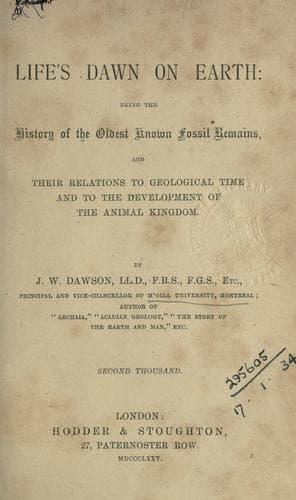
Life's Dawn on Earth: Being the history of the oldest known fossil remains, and their relations to geological time and to the development of the animal kingdom — John Shaqi
Life's Dawn on Earth: Being the history of the oldest known fossil remains, and their relations to geological time and to the development of the animal kingdomDawson, John William, Sir
History
Life's Dawn on Earth: Being the history of the oldest known fossil remains, and their relations to geological time and to the development of the animal kingdom
Dawson, John William, Sir
Life -- Origin; Paleontology -- Precambrian
The name Laurentian, given originally to the Canadian development of
these rocks by Sir William Logan, but now applied to them throughout
the world, is derived from a range of hills lying north of the
St. Lawrence valley, which the old French geographers named the
Laurentides. In these hills the harder rocks of this old formation
rise to considerable heights, and form the highlands separating the
St. Lawrence valley from the great plain fronting on Hudson's Bay
and the Arctic Sea. At first sight it may seem strange that rocks so
ancient should anywhere appear at the surface, especially on the tops
of hills; but this is a necessary result of the mode of formation of
our continents. The most ancient sediments deposited in the sea were
those first elevated into land, and first altered and hardened by heat.
Upheaved in the folding of the earth's crust into high and rugged
ridges, they have either remained uncovered with newer sediments, or
have had such as were deposited on them washed away; and being of a
hard and resisting nature, they have remained comparatively unworn when
rocks much more modern have been swept off by denuding agencies.
But the exposure of the old Laurentian skeleton of mother earth is not
confined to the Laurentide Hills, though these have given the formation
its name. The same ancient rocks appear in the Adirondack mountains
of New York, and in the patches which at lower levels protrude from
beneath the newer formations along the American coast from Newfoundland
to Maryland. The older gneisses of Norway, Sweden, and the Hebrides,
of Bavaria and Bohemia, belong to the same age, and it is not unlikely
that similar rocks in many other parts of the old continent will be
found to be of as great antiquity. In no part of the world, however,
are the Laurentian rocks more extensively distributed or better
known than in North America; and to this as the grandest and most
instructive development of them, and that which first afforded organic
remains, we may more especially devote our attention. Their general
relations to the other formations of America may be learned from the
rough generalised section (fig. 1); in which the crumpled and contorted
Laurentian strata of Canada are seen to underlie unconformably the
comparatively flat Silurian beds, which are themselves among the oldest
monuments of the geological history of the earth.
[Illustration: Fig. 1. _General Section, showing the Relations of
the Laurentian and Palæozoic Rocks in Canada._ (L.) Laurentian. (1.)
Cambrian, or Primordial. (2.) Lower Silurian. (3.) Upper Silurian. (4.)
Devonian and Carboniferous.]
Public-domain text, read in full here on John Shaqi.
Reviews
Reviews
No reviews yet
Be the first to share your thoughts on this work.
Join the Discussion
Join the discussion
Sign in to leave a comment or review.
Sign InorCreate an account