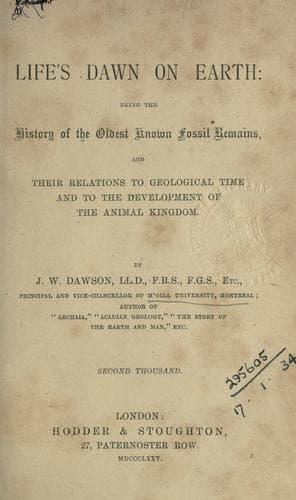
Life's Dawn on Earth: Being the history of the oldest known fossil remains, and their relations to geological time and to the development of the animal kingdomDawson, John William, Sir
History
Life's Dawn on Earth: Being the history of the oldest known fossil remains, and their relations to geological time and to the development of the animal kingdom
Dawson, John William, Sir
Life -- Origin; Paleontology -- Precambrian
"9th. We have shown that the relative position of two superposed
asbestiform layers (an _upper_ and an _under_ 'proper wall'), and the
admitted fact of their component aciculi often passing continuously
and without interruption from one 'chamber cast' to another, to the
exclusion of the 'intermediate skeleton,' are totally incompatible
with the idea of the 'nummuline layer' having resulted from
pseudopodial tubulation.
"10th. The so-called 'stolons' and 'passages of communication
exactly corresponding with those described in _Cycloclypeus_,'
have been shown to be tabular crystals and variously formed bodies,
belonging to different minerals, wedged crossways or obliquely in the
calcareous interspaces between the grains and plates of serpentine.
"11th. The 'canal system' is composed of serpentine, or malacolite.
Its typical kinds in the first of these minerals may be traced in
all stages of formation out of plates, prisms, and other solids,
undergoing a process of superficial decretion. Those in malacolite
are made up of crystals--single, or aggregated together--that have
had their planes, angles, and edges rounded off; or have become
further reduced by some solvent.
"12th. The 'canal system' in its remarkable branching varieties is
completely paralleled by crystalline configurations in the coccolite
marble of Aker, in Sweden; and in the crevices of a crystal of spinel
imbedded in a calcitic matrix from Amity, New York.
"13th. The _configurations_, presumed to represent the 'canal
systems,' are _totally without any regularity_ of form, of relative
size, or of arrangement; and they occur independently of and apart
from other 'eozoonal features' (Amity, Boden, etc.); facts not only
demonstrating them to be purely mineral products, but which strike at
the root of the idea that they are of organic origin.
"14th. In answer to the argument that as all the foregoing 'eozoonal
features' are occasionally found together in ophite, the combination
must be considered a conclusive evidence of their organic origin,
we have shown, from the composition, physical characters, and
circumstances of occurrence and association of their component
serpentine, that they represent the structural and chemical changes
which are eminently and peculiarly characteristic of this mineral.
It has also been shown that the combination is paralleled to a
remarkable extent in chondrodite and its calcitic matrix.
"15th. The 'regular alternation of lamellæ of calcareous and
silicious minerals' (respectively representing the 'intermediate
skeleton' and 'chamber casts') occasionally seen in ophite, and
considered to be a 'fundamental fact' evidencing an organic
arrangement, is proved to be a _mineralogical_ phenomenon by the
fact that a similar alternation occurs in amphiboline-calcitic
marbles, and gneissose rocks.
Public-domain text, read in full here on John Shaqi.
Reviews
Reviews
No reviews yet
Be the first to share your thoughts on this work.
Elsewhere in the archive
Join the Discussion
Join the discussion
Sign in to leave a comment or review.
Sign InorCreate an account