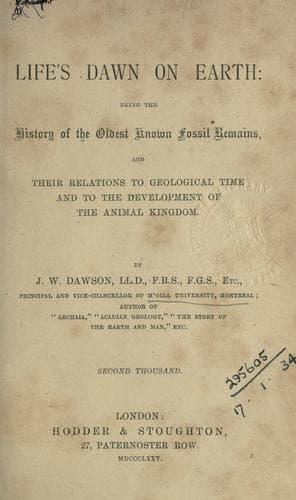
Life's Dawn on Earth: Being the history of the oldest known fossil remains, and their relations to geological time and to the development of the animal kingdomDawson, John William, Sir
History
Life's Dawn on Earth: Being the history of the oldest known fossil remains, and their relations to geological time and to the development of the animal kingdom
Dawson, John William, Sir
Life -- Origin; Paleontology -- Precambrian
"16th. In order to account for certain _untoward_ difficulties
presented by the configurations forming the 'canal system,' and
the aciculi of the 'nummuline layer'--that is, when they occur as
'_solid bundles_'--or are '_closely packed_'--or '_appear to be
glued together_'--Dr. Carpenter has proposed the theory that the
sarcodic extensions which they are presumed to represent have been
'turned into stone' (a 'silicious mineral') 'by Nature's cunning'
('just as the sarcodic layer on the surface of the shell of living
Foraminifers is formed by the spreading out of _coalesced_ bundles
of the pseudopodia that have emerged from the chamber wall')--'by
a process of chemical substitution _before_ their destruction by
ordinary decomposition.' We showed this quasi-alchymical theory to be
altogether unscientific.
"17th. The 'silicious mineral' (serpentine) has been analogued with
those forming the variously-formed casts (in 'glauconite,' etc.)
of recent and fossil Foraminifers. We have shown that the mineral
silicates of Eozoon have no relation whatever to the substances
composing such casts.
"18th. Dr. Hunt, in order to account for the serpentine, loganite,
and malacolite, being the presumed in-filling substances of Eozoon,
has conceived the 'novel doctrine,' that such minerals were
_directly_ deposited in the ocean waters in which this 'fossil'
lived. We have gone over all his evidences and arguments without
finding _one_ to be substantiated.
"19th. Having investigated the alleged cases of 'chambers' and
'tubes' occurring 'filled with calcite,' and presumed to be 'a
conclusive answer to' our 'objections,' we have shown that there are
the strongest grounds for removing them from the category of reliable
evidences on the side of the organic doctrine. The Tudor specimen has
been shown to be equally unavailable.
"20th. The occurrence of the best preserved specimens of Eozoon
Canadense in rocks that are in a '_highly crystalline condition_'
(Dawson) must be accepted as a fact utterly fatal to its organic
origin.
"21st. The occurrence of 'eozoonal features' _solely_ in crystalline
or metamorphosed rocks, belonging to the Laurentian, the Lower
Silurian, and the Liassic systems--never in ordinary unaltered
deposits of these and the intermediate systems--must be assumed as
completely demonstrating their purely mineral origin."
The answers already given to these objections may be summed up
severally as follows:--
1st. This is a mere hypothesis to account for the forms presented by
serpentine grains and by Eozoon. Hunt has shown that it is untenable
chemically, and has completely exploded it in his recent papers on
Chemistry and Geology.[AP] My own observations show that it does not
accord with the mode of occurrence of serpentine in the Laurentian
limestones of Canada.
[Footnote AP: Boston, 1874.]
Public-domain text, read in full here on John Shaqi.
Reviews
Reviews
No reviews yet
Be the first to share your thoughts on this work.
Elsewhere in the archive
Join the Discussion
Join the discussion
Sign in to leave a comment or review.
Sign InorCreate an account