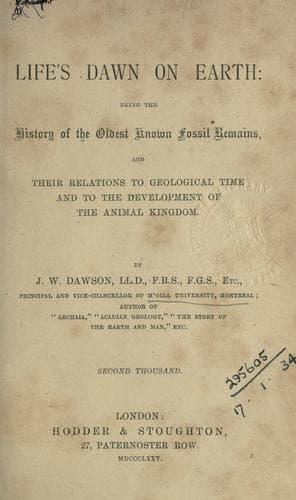
Life's Dawn on Earth: Being the history of the oldest known fossil remains, and their relations to geological time and to the development of the animal kingdomDawson, John William, Sir
History
Life's Dawn on Earth: Being the history of the oldest known fossil remains, and their relations to geological time and to the development of the animal kingdom
Dawson, John William, Sir
Life -- Origin; Paleontology -- Precambrian
Further, the authors of the paper have no right to object to our
regarding the laminated specimen as "typical" Eozoon. If the question
were as to _typical ophite_ the case would be different; but the
question actually is as to certain well-defined forms which we regard
as fossils, and allege to have organic structure on the small scale,
as well as lamination on the large scale. We profess to account for
the acervuline forms by the irregular growth at the surface of the
organisms, and by the breaking of them into fragments confusedly
intermingled in great thicknesses of limestone, just as fragments of
corals occur in Palæozoic limestones; but we are under no obligation
to accept irregular or disintegrated specimens as typical; and when
objectors reason from these fragments, we have a right to point to
the more perfect examples. It would be easy to explain the loose
cells of _Tetradium_ which characterize the bird's-eye limestone
of the Lower Silurian of America, as crystalline structures; but
a comparison with the unbroken masses of the same coral, shows
their true nature. I have for some time made the minute structure
of Palæozoic limestones a special study, and have described some
of them from the Silurian formations of Canada.[AS] I possess now
many additional examples, showing fragments of various kinds of
fossils preserved in these limestones, and recognisable only by the
infiltration of their pores with different silicious minerals. It can
also be shown that in many cases the crystallization of the carbonate
of lime, both of the fossils themselves and of their matrix, has
not interfered with the perfection of the most minute of these
structures.
[Footnote AS: In the _Canadian Naturalist_.]
Public-domain text, read in full here on John Shaqi.
Reviews
Reviews
No reviews yet
Be the first to share your thoughts on this work.
Elsewhere in the archive
Join the Discussion
Join the discussion
Sign in to leave a comment or review.
Sign InorCreate an account