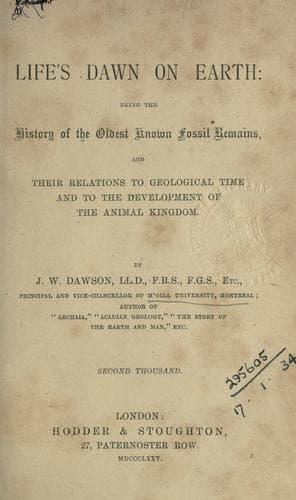
Life's Dawn on Earth: Being the history of the oldest known fossil remains, and their relations to geological time and to the development of the animal kingdomDawson, John William, Sir
History
Life's Dawn on Earth: Being the history of the oldest known fossil remains, and their relations to geological time and to the development of the animal kingdom
Dawson, John William, Sir
Life -- Origin; Paleontology -- Precambrian
The fact that the chambers are usually filled with silicates is
strangely regarded by the authors as an argument against the organic
nature of Eozoon. One would think that the extreme frequency of
silicious fillings of the cavities of fossils, and even of silicious
replacement of their tissues, should have prevented the use of such
an argument, without taking into account the opposite conclusions to
be drawn from the various kinds of silicates found in the specimens,
and from the modern filling of Foraminifera by hydrous silicates, as
shown by Ehrenberg, Mantell, Carpenter, Bailey, and Pourtales.[AT]
Further, I have elsewhere shown that the loganite is proved by its
texture to have been a fragmental substance, or at least filled
with loose _debris_; that the Tudor specimens have the cavities
filled with a sedimentary limestone, and that several fragmental
specimens from Madoc are actually wholly calcareous. It is to be
observed, however, that the wholly calcareous specimens present
great difficulties to an observer; and I have no doubt that they are
usually overlooked by collectors in consequence of their not being
developed by weathering, or showing any obvious structure in fresh
fractures.
[Footnote AT: _Quarterly Journal Geol. Society_, 1864.]
3. With regard to the canal system, the authors persist in
confusing the casts of it which occur in serpentine with "metaxite"
concretions, and in likening them to dendritic crystallizations of
silver, etc., and coralloidal forms of carbonate of lime. In answer
to this, I think it quite sufficient to say that I fail to perceive
the resemblance as other than very imperfectly imitative. I may add,
that the case is one of the occurrence of a canal structure in forms
which on other grounds appear to be organic, while the concretionary
forms referred to are produced under diverse conditions, none of
them similar to those of which evidence appears in the specimens of
Eozoon. With the singular theory of pseudomorphism, by means of which
the authors now supplement their previous objections, I leave Dr.
Hunt to deal.
Public-domain text, read in full here on John Shaqi.
Reviews
Reviews
No reviews yet
Be the first to share your thoughts on this work.
Elsewhere in the archive
Join the Discussion
Join the discussion
Sign in to leave a comment or review.
Sign InorCreate an account