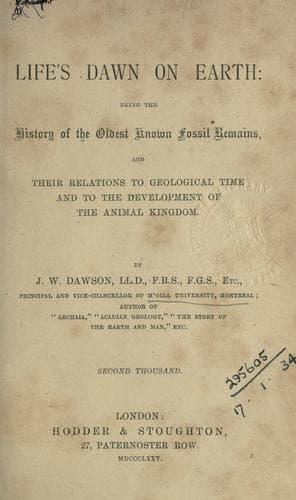
Life's Dawn on Earth: Being the history of the oldest known fossil remains, and their relations to geological time and to the development of the animal kingdomDawson, John William, Sir
History
Life's Dawn on Earth: Being the history of the oldest known fossil remains, and their relations to geological time and to the development of the animal kingdom
Dawson, John William, Sir
Life -- Origin; Paleontology -- Precambrian
4. With respect to the proper wall and its minute tubulation, the
essential error of the authors consists in confounding it with
fibrous and acicular crystals, and in maintaining that because the
tubuli are sometimes apparently confused and confluent they must
be inorganic. With regard to the first of these positions, I may
repeat what I have stated in former papers--that the true cell-wall
presents minute cylindrical processes traversing carbonate of lime,
and usually nearly parallel to each other, and often slightly
bulbose at the extremity. Fibrous serpentine, on the other hand,
appears as angular crystals, closely packed together, while the
numerous spicular crystals of silicious minerals which often appear
in metamorphic limestones, and may be developed by decalcification,
appear as sharp angular needles usually radiating from centres or
irregularly disposed. Their own plate (Ophite from Skye, King and
Rowney's Paper, _Proc. R. I. A._, vol. x.), is an eminent example
of this; and whatever the nature of the crystals represented, they
have no appearance of being true tubuli of Eozoon. I have very often
shown microscopists and geologists the cell-wall along with veins of
chrysotile and coatings of acicular crystals occurring in the same or
similar limestones, and they have never failed at once to recognise
the difference, especially under high powers.
I do not deny that the tubulation is often imperfectly preserved,
and that in such cases the casts of the tubuli may appear to be
glued together by concretions of mineral matter, or to be broken
or imperfect. But this occurs in all fossils, and is familiar to
any microscopist examining them. How difficult is it in many cases
to detect the minute structure of Nummulites and other fossil
Foraminifera? How often does a specimen of fossil wood present in one
part distorted and confused fibres or mere crystals, with the remains
of the wood forming phragmata between them, when in other parts it
may show the most minute structures in perfect preservation? But
who would use the disintegrated portions to invalidate the evidence
of the parts better preserved? Yet this is precisely the argument
of Professors King and Rowney, and which they have not hesitated
in using in the case of a fossil so old as Eozoon, and so often
compressed, crushed, and partly destroyed by mineralization.
Public-domain text, read in full here on John Shaqi.
Reviews
Reviews
No reviews yet
Be the first to share your thoughts on this work.
Elsewhere in the archive
Join the Discussion
Join the discussion
Sign in to leave a comment or review.
Sign InorCreate an account