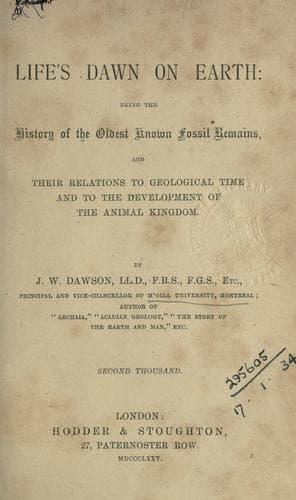
Life's Dawn on Earth: Being the history of the oldest known fossil remains, and their relations to geological time and to the development of the animal kingdomDawson, John William, Sir
History
Life's Dawn on Earth: Being the history of the oldest known fossil remains, and their relations to geological time and to the development of the animal kingdom
Dawson, John William, Sir
Life -- Origin; Paleontology -- Precambrian
Assuming the Laurentian rocks to be altered sediments, they must, from
their great extent, have been deposited in the ocean; and if there had
been no living creatures in the waters, we have no reason to believe
that they would have consisted of anything more than such sandy and
muddy debris as may be washed away from wasting rocks originally of
igneous origin. But the Laurentian beds contain other materials than
these. No formations of any geological age include thicker or more
extensive limestones. One of the beds measured by the officers of the
Geological Survey, is stated to be 1500 feet in thickness, another is
1250 feet thick, and a third 750 feet; making an aggregate of 3500
feet.[B] These beds may be traced, with more or less interruption,
for hundreds of miles. Whatever the origin of such limestones, it
is plain that they indicate causes equal in extent, and comparable
in power and duration, with those which have produced the greatest
limestones of the later geological periods. Now, in later formations,
limestone is usually an organic rock, accumulated by the slow gathering
from the sea-water, or its plants, of calcareous matter, by corals,
foraminifera, or shell-fish, and the deposition of their skeletons,
either entire or in fragments, in the sea-bottom. The most friable
chalk and the most crystalline limestones have alike been formed in
this way. We know of no reason why it should be different in the
Laurentian period. When, therefore, we find great and conformable
beds of limestone, such as those described by Sir William Logan in
the Laurentian of Canada, we naturally imagine a quiet sea-bottom, in
which multitudes of animals of humble organization were accumulating
limestone in their hard parts, and depositing this in gradually
increasing thickness from age to age. Any attempts to account otherwise
for these thick and greatly extended beds, regularly interstratified
with other deposits, have so far been failures, and have arisen either
from a want of comprehension of the nature and magnitude of the
appearances to be explained, or from the error of mistaking the true
bedded limestones for veins of calcareous spar.
[Footnote B: Logan: _Geology of Canada_, p. 45.]
Public-domain text, read in full here on John Shaqi.
Reviews
Reviews
No reviews yet
Be the first to share your thoughts on this work.
Join the Discussion
Join the discussion
Sign in to leave a comment or review.
Sign InorCreate an account