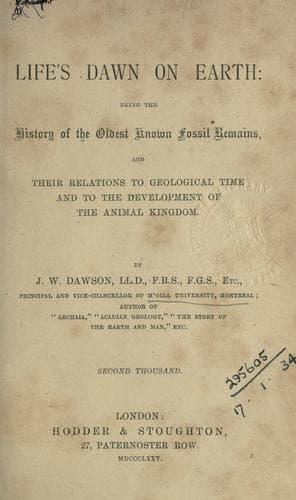
Life's Dawn on Earth: Being the history of the oldest known fossil remains, and their relations to geological time and to the development of the animal kingdomDawson, John William, Sir
History
Life's Dawn on Earth: Being the history of the oldest known fossil remains, and their relations to geological time and to the development of the animal kingdom
Dawson, John William, Sir
Life -- Origin; Paleontology -- Precambrian
The Laurentian rocks contain great quantities of carbon, in the form of
graphite or plumbago. This does not occur wholly, or even principally,
in veins or fissures, but in the substance of the limestone and gneiss,
and in regular layers. So abundant is it, that I have estimated the
amount of carbon in one division of the Lower Laurentian of the Ottawa
district at an aggregate thickness of not less than twenty to thirty
feet, an amount comparable with that in the true coal formation itself.
Now we know of no agency existing in present or in past geological
time capable of deoxidizing carbonic acid, and fixing its carbon as
an ingredient in permanent rocks, except vegetable life. Unless,
therefore, we suppose that there existed in the Laurentian age a vast
abundance of vegetation, either in the sea or on the land, we have no
means of explaining the Laurentian graphite.
The Laurentian formation contains great beds of oxide of iron,
sometimes seventy feet in thickness. Here again we have an evidence of
organic action; for it is the deoxidizing power of vegetable matter
which has in all the later formations been the efficient cause in
producing bedded deposits of iron. This is the case in modern bog and
lake ores, in the clay iron-stones of the coal measures, and apparently
also in the great ore beds of the Silurian rocks. May not similar
causes have been at work in the Laurentian period?
Any one of these reasons might, in itself, be held insufficient to
prove so great and, at first sight, unlikely a conclusion as that of
the existence of abundant animal and vegetable life in the Laurentian;
but the concurrence of the whole in a series of deposits unquestionably
marine, forms a chain of evidence so powerful that it might command
belief even if no fragment of any organic and living form or structure
had ever been recognised in these ancient rocks.
Such was the condition of the matter until the existence of supposed
organic remains was announced by Sir W. Logan, at the American
Association for the Advancement of Science, in Springfield, in 1859;
and we may now proceed to narrate the manner of this discovery, and how
it has been followed up.
Public-domain text, read in full here on John Shaqi.
Reviews
Reviews
No reviews yet
Be the first to share your thoughts on this work.
Join the Discussion
Join the discussion
Sign in to leave a comment or review.
Sign InorCreate an account