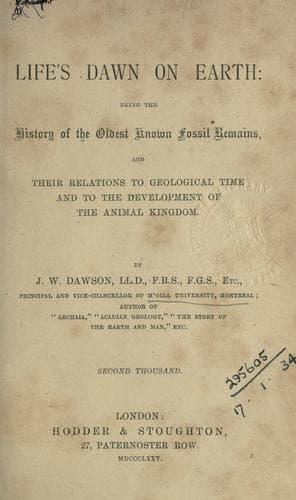
Life's Dawn on Earth: Being the history of the oldest known fossil remains, and their relations to geological time and to the development of the animal kingdomDawson, John William, Sir
History
Life's Dawn on Earth: Being the history of the oldest known fossil remains, and their relations to geological time and to the development of the animal kingdom
Dawson, John William, Sir
Life -- Origin; Paleontology -- Precambrian
[_Journal of Geological Society of London_, February, 1865.]
After stating the division of the Laurentian series into the two
great groups of the Upper and Lower Laurentian, Sir William goes on
to say:--
"The united thickness of these two groups in Canada cannot be less
than 30,000 feet, and probably much exceeds it. The Laurentian of
the west of Scotland, according to Sir Roderick Murchison, also
attains a great thickness. In that region the Upper Laurentian or
Labrador series, has not yet been separately recognised; but from
Mr. McCulloch's description, as well as from the specimens collected
by him, and now in the Museum of the Geological Society of London,
it can scarcely be doubted that the Labrador series occurs in Skye.
The labradorite and hypersthene rocks from that island are identical
with those of the Labrador series in Canada and New York, and unlike
those of any formation at any other known horizon. This resemblance
did not escape the notice of Emmons, who, in his description of the
Adirondack Mountains, referred these rocks to the hypersthene rock
of McCulloch, although these observers, on the opposite sides of
the Atlantic, looked upon them as unstratified. In the _Canadian
Naturalist_ for 1862, Mr. Thomas Macfarlane, for some time resident
in Norway, and now in Canada, drew attention to the striking
resemblance between the Norwegian primitive gneiss formation, as
described by Naumann and Keilhau, and observed by himself, and the
Laurentian, including the Labrador group; and the equally remarkable
similarity of the lower part of the primitive slate formation
to the Huronian series, which is a third Canadian group. These
primitive series attain a great thickness in the north of Europe, and
constitute the main features of Scandinavian geology.
Public-domain text, read in full here on John Shaqi.
Reviews
Reviews
No reviews yet
Be the first to share your thoughts on this work.
Join the Discussion
Join the discussion
Sign in to leave a comment or review.
Sign InorCreate an account