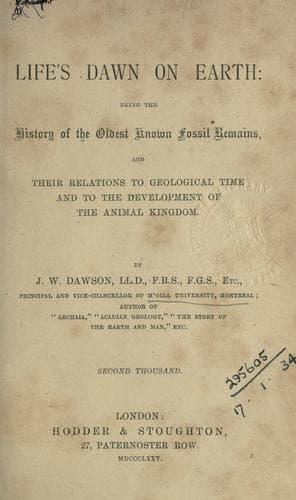
Life's Dawn on Earth: Being the history of the oldest known fossil remains, and their relations to geological time and to the development of the animal kingdomDawson, John William, Sir
History
Life's Dawn on Earth: Being the history of the oldest known fossil remains, and their relations to geological time and to the development of the animal kingdom
Dawson, John William, Sir
Life -- Origin; Paleontology -- Precambrian
"In Bavaria and Bohemia there is an ancient gneissic series. After
the labours in Scotland, by which he was the first to establish a
Laurentian equivalent in the British Isles, Sir Roderick Murchison,
turning his attention to this central European mass, placed it on the
same horizon. These rocks, underlying Barrande's Primordial zone,
with a great development of intervening clay-slate, extend southward
in breadth to the banks of the Danube, with a prevailing dip towards
the Silurian strata. They had previously been studied by Gümbel and
Crejci, who divided them into an older reddish gneiss and a newer
grey gneiss. But, on the Danube, the mass which is furthest removed
from the Silurian rocks being a grey gneiss, Gümbel and Crejci
account for its presence by an inverted fold in the strata; while
Sir Roderick places this at the base, and regards the whole as a
single series, in the normal fundamental position of the Laurentian
of Scotland and of Canada. Considering the colossal thickness given
to the series (90,000 feet), it remains to be seen whether it may
not include both the Lower and Upper Laurentian, and possibly, in
addition, the Huronian.
"This third Canadian group (the Huronian) has been shown by my
colleague, Mr. Murray, to be about 18,000 feet thick, and to consist
chiefly of quartzites, slate-conglomerates, diorites, and limestones.
The horizontal strata which form the base of the Lower Silurian in
western Canada, rest upon the upturned edges of the Huronian series;
which, in its turn, unconformably overlies the Lower Laurentian. The
Huronian is believed to be more recent than the Upper Laurentian
series, although the two formations have never yet been seen in
contact.
"The united thickness of these three great series may possibly
far surpass that of all the succeeding rocks from the base of the
Palæozoic series to the present time. We are thus carried back to a
period so far remote, that the appearance of the so-called Primordial
fauna may by some be considered a comparatively modern event. We,
however, find that, even during the Laurentian period, the same
chemical and mechanical processes which have ever since been at
work disintegrating and reconstructing the earth's crust were in
operation as now. In the conglomerates of the Huronian series there
are enclosed boulders derived from the Laurentian, which seem to show
that the parent rock was altered to its present crystalline condition
before the deposit of the newer formation; while interstratified with
the Laurentian limestones there are beds of conglomerate, the pebbles
of which are themselves rolled fragments of a still older laminated
sand-rock, and the formation of these beds leads us still further
into the past.
Public-domain text, read in full here on John Shaqi.
Reviews
Reviews
No reviews yet
Be the first to share your thoughts on this work.
Join the Discussion
Join the discussion
Sign in to leave a comment or review.
Sign InorCreate an account