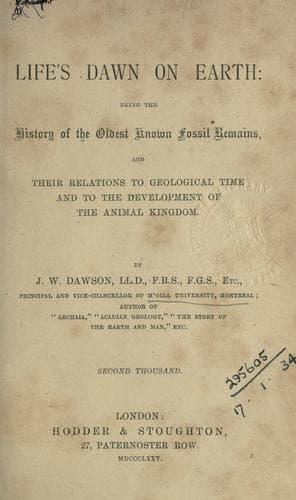
Life's Dawn on Earth: Being the history of the oldest known fossil remains, and their relations to geological time and to the development of the animal kingdom — John Shaqi
Life's Dawn on Earth: Being the history of the oldest known fossil remains, and their relations to geological time and to the development of the animal kingdomDawson, John William, Sir
History
Life's Dawn on Earth: Being the history of the oldest known fossil remains, and their relations to geological time and to the development of the animal kingdom
Dawson, John William, Sir
Life -- Origin; Paleontology -- Precambrian
"We may sum up these facts and considerations in the following
statements:--First, that somewhat obscure traces of organic structure
can be detected in the Laurentian graphite; secondly, that the
general arrangement and microscopic structure of the substance
corresponds with that of the carbonaceous and bituminous matters
in marine formations of more modern date; thirdly, that if the
Laurentian graphite has been derived from vegetable matter, it has
only undergone a metamorphosis similar in kind to that which organic
matter in metamorphosed sediment of later age has experienced;
fourthly, that the association of the graphitic matter with organic
limestone, beds of iron ore, and metallic sulphides, greatly
strengthens the probability of its vegetable origin; fifthly, that
when we consider the immense thickness and extent of the Eozoonal
and graphitic limestones and iron ore deposits of the Laurentian, if
we admit the organic origin of the limestone and graphite, we must
be prepared to believe that the life of that early period, though it
may have existed under low forms, was most copiously developed, and
that it equalled, perhaps surpassed, in its results, in the way of
geological accumulation, that of any subsequent period."
(D.) Western and other Laurentian Rocks, etc.
In the map of the Laurentian nucleus of America (fig. 4,) I have
not inserted the Laurentian rocks believed to exist in the Rocky
Mountains and other western ranges. Their distribution is at present
uncertain, as well as the date of their elevation. They may indicate
an old line of Laurentian fracture or wrinkling, parallel to the west
coast, and defining its direction. In the map there should be a patch
of Laurentian in the north of Newfoundland, and it should be wider at
the west end of lake Superior.
Public-domain text, read in full here on John Shaqi.
Reviews
Reviews
No reviews yet
Be the first to share your thoughts on this work.
Join the Discussion
Join the discussion
Sign in to leave a comment or review.
Sign InorCreate an account