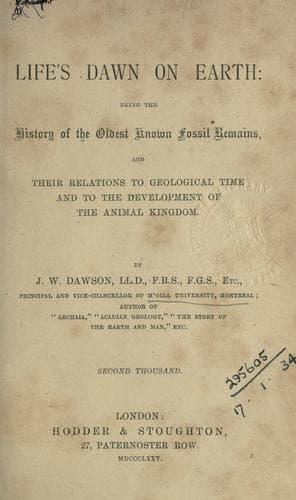
Life's Dawn on Earth: Being the history of the oldest known fossil remains, and their relations to geological time and to the development of the animal kingdomDawson, John William, Sir
History
Life's Dawn on Earth: Being the history of the oldest known fossil remains, and their relations to geological time and to the development of the animal kingdom
Dawson, John William, Sir
Life -- Origin; Paleontology -- Precambrian
"When palæozoic land-plants have been converted into graphite,
they sometimes perfectly retain their structure. Mineral charcoal,
with structure, exists in the graphitic coal of Rhode Island. The
fronds of ferns, with their minutest veins perfect, are preserved
in the Devonian shales of St. John, in the state of graphite; and
in the same formation there are trunks of Conifers (_Dadoxylon
ouangondianum_) in which the material of the cell-walls has been
converted into graphite, while their cavities have been filled with
calcareous spar and quartz, the finest structures being preserved
quite as well as in comparatively unaltered specimens from the
coal-formation.[I] No structures so perfect have as yet been detected
in the Laurentian, though in the largest of the three graphitic beds
at St. John there appear to be fibrous structures which I believe may
indicate the existence of land-plants. This graphite is composed of
contorted and slickensided laminæ, much like those of some bituminous
shales and coarse coals; and in these there are occasional small
pyritous masses which show hollow carbonaceous fibres, in some cases
presenting obscure indications of lateral pores. I regard these
indications, however, as uncertain; and it is not as yet fully
ascertained that these beds at St. John are on the same geological
horizon with the Lower Laurentian of Canada, though they certainly
underlie the Primordial series of the Acadian group, and are
separated from it by beds having the character of the Huronian.
[Footnote I: _Acadian Geology_, p. 535. In calcified specimens the
structures remain in the graphite after decalcification by an acid.]
"There is thus no absolute impossibility that distinct organic
tissues may be found in the Laurentian graphite, if formed from
land-plants, more especially if any plants existed at that time
having true woody or vascular tissues; but it cannot with certainty
be affirmed that such tissues have been found. It is possible,
however, that in the Laurentian period the vegetation of the land may
have consisted wholly of cellular plants, as, for example, mosses and
lichens; and if so, there would be comparatively little hope of the
distinct preservation of their forms or tissues, or of our being able
to distinguish the remains of land-plants from those of Algæ.
Public-domain text, read in full here on John Shaqi.
Reviews
Reviews
No reviews yet
Be the first to share your thoughts on this work.
Join the Discussion
Join the discussion
Sign in to leave a comment or review.
Sign InorCreate an account