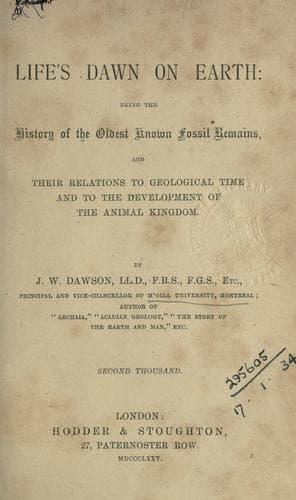
Life's Dawn on Earth: Being the history of the oldest known fossil remains, and their relations to geological time and to the development of the animal kingdomDawson, John William, Sir
History
Life's Dawn on Earth: Being the history of the oldest known fossil remains, and their relations to geological time and to the development of the animal kingdom
Dawson, John William, Sir
Life -- Origin; Paleontology -- Precambrian
[Footnote N: By Mr. Bicknell at Newbury, and Mr. Burbank at Chelmsford.
The latter gentleman has since maintained that the limestones at the
latter place are not true beds; but his own descriptions and figures,
lead to the belief that this is an error of observation on his part.
The Eozoon in the Chelmsford specimens and in those of Warren, New
York, is in small and rare fragments in serpentinous limestone.]
Eozoon is not, however, the only witness to the great fact of
Laurentian life, of which it is the most conspicuous exponent. In many
of the Laurentian limestones, mixed with innumerable fragments of
Eozoon, there are other fragments with traces of organic structure of
a different character. There are also casts in silicious matter which
seem to indicate smaller species of Foraminifera. There are besides to
be summoned in evidence the enormous accumulations of carbon already
referred to as existing in the Laurentian rocks, and the worm-burrows,
of which very perfect traces exist in rocks probably of Upper Eozoic
age.
Other discoveries also are foreshadowed here. The microscope may
yet detect the true nature and affinities of some of the fragments
associated with Eozoon. Less altered portions of the Laurentian rocks
may be found, where even the vegetable matter may retain its organic
forms, and where fossils may be recognised by their external outlines
as well as by their internal structure. The Upper Laurentian and the
Huronian have yet to yield up their stores of life. Thus the time may
come when the rocks now called Primordial shall not be held to be so
in any strict sense, and when swarming dynasties of Protozoa and other
low forms of life may be known as inhabitants of oceans vastly ancient
as compared with even the old Primordial seas. Who knows whether even
the land of the Laurentian time may not have been clothed with plants,
perhaps as much more strange and weird than those of the Devonian and
Carboniferous, as those of the latter are when compared with modern
forests?
NOTES TO CHAPTER III.
(A.) Sir William E. Logan on the Discovery and Characters of Eozoon.
[_Journal of Geological Society_, February, 1865.]
Public-domain text, read in full here on John Shaqi.
Reviews
Reviews
No reviews yet
Be the first to share your thoughts on this work.
Join the Discussion
Join the discussion
Sign in to leave a comment or review.
Sign InorCreate an account