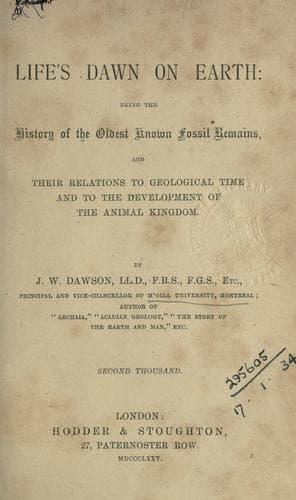
Life's Dawn on Earth: Being the history of the oldest known fossil remains, and their relations to geological time and to the development of the animal kingdom — John Shaqi
Life's Dawn on Earth: Being the history of the oldest known fossil remains, and their relations to geological time and to the development of the animal kingdomDawson, John William, Sir
History
Life's Dawn on Earth: Being the history of the oldest known fossil remains, and their relations to geological time and to the development of the animal kingdom
Dawson, John William, Sir
Life -- Origin; Paleontology -- Precambrian
"In the examination of these ancient rocks, the question has often
naturally occurred to me, whether during these remote periods, life
had yet appeared on the earth. The apparent absence of fossils from
the highly crystalline limestones did not seem to offer a proof in
the negative, any more than their undiscovered presence in newer
crystalline limestones where we have little doubt they have been
obliterated by metamorphic action; while the carbon which, in the
form of graphite, constitutes beds, or is disseminated through the
calcareous or siliceous strata of the Laurentian series, seems to be
an evidence of the existence of vegetation, since no one disputes the
organic character of this mineral in more recent rocks. My colleague,
Dr. T. Sterry Hunt, has argued for the existence of organic matters
at the earth's surface during the Laurentian period from the presence
of great beds of iron ore, and from the occurrence of metallic
sulphurets;[O] and finally, the evidence was strengthened by the
discovery of supposed organic forms. These were first brought to me,
in October, 1858, by Mr. J. McMullen, then attached as an explorer to
the Geological Survey of the province, from one of the limestones of
the Laurentian series occurring at the Grand Calumet, on the river
Ottawa.
[Footnote O: _Quarterly Journal of the Geological Society_, xv., 493.]
"Any organic remains which may have been entombed in these limestones
would, if they retained their calcareous character, be almost
certainly obliterated by crystallization; and it would only be by the
replacement of the original carbonate of lime by a different mineral
substance, or by an infiltration of such a substance into all the
pores and spaces in and about the fossil, that its form would be
preserved. The specimens from the Grand Calumet present parallel or
apparently concentric layers resembling those of Stromatopora, except
that they anastomose at various points. What were first considered
the layers are composed of crystallized pyroxene, while the then
supposed interstices consist of carbonate of lime. These specimens,
one of which is figured in _Geology of Canada_, p. 49, called to
memory others which had some years previously been obtained from Dr.
James Wilson, of Perth, and were then regarded merely as minerals.
They came, I believe, from masses in Burgess, but whether in place
is not quite certain; and they exhibit similar forms to those of the
Grand Calumet, composed of layers of a dark green magnesian silicate
(loganite); while what were taken for the interstices are filled with
crystalline dolomite. If the specimens from both these places were to
be regarded as the result of unaided mineral arrangement, it appeared
to me strange that identical forms should be derived from minerals
of such different composition. I was therefore disposed to look
Public-domain text, read in full here on John Shaqi.
Reviews
Reviews
No reviews yet
Be the first to share your thoughts on this work.
Join the Discussion
Join the discussion
Sign in to leave a comment or review.
Sign InorCreate an account