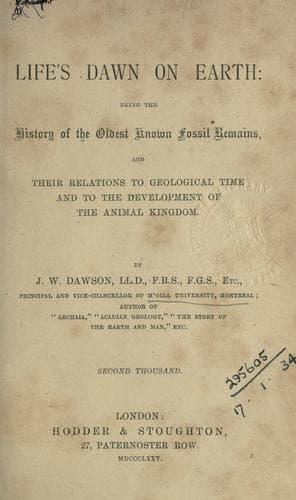
Life's Dawn on Earth: Being the history of the oldest known fossil remains, and their relations to geological time and to the development of the animal kingdom — John Shaqi
Life's Dawn on Earth: Being the history of the oldest known fossil remains, and their relations to geological time and to the development of the animal kingdomDawson, John William, Sir
History
Life's Dawn on Earth: Being the history of the oldest known fossil remains, and their relations to geological time and to the development of the animal kingdom
Dawson, John William, Sir
Life -- Origin; Paleontology -- Precambrian
2. Grayish and flesh-coloured gneiss, sometimes hornblendic,
passing towards the summit into a dark mica-schist,
and including portions of greenish-white diorite;
mean of several pretty closely agreeing measurements, 10,400
3. Crystalline limestone, sometimes magnesian, including
lenticular patches of quartz, and broken and
contorted layers of quartzo-felspathic rock, rarely above
a few inches in thickness. This limestone, which includes
in Elzivir a one-foot bed of graphite, is sometimes
very thin, but in other places attains a thickness
of 750 feet; estimated as averaging 400
4. Hornblendic and dioritic rocks, massive or schistose,
occasionally associated near the base with dark
micaceous schists, and also with chloritic and epidotic
rocks, including beds of magnetite; average thickness 4,200
5. Crystalline and somewhat granular magnesian
limestone, occasionally interstratified with diorites, and
near the base with silicious slates and small beds of
impure steatite 330
This limestone, which is often silicious and ferruginous,
is metalliferous, holding disseminated copper
pyrites, blende, mispickel, and iron pyrites, the latter
also sometimes in beds of two or three feet. Gold occurs
in the limestone at the village of Madoc, associated with
an argentiferous gray copper ore, and in irregular veins
with bitter-spar, quartz, and a carbonaceous matter, at
the Richardson mine in Madoc.
6. Gray silicious or fined-grained mica-slates, with
an interstratified mass of about sixty feet of yellowish-white
dolomite divided into beds by thin layers of the
mica-slate, which, as well as the dolomite, often becomes
conglomerate, including rounded masses of gneiss and
quartzite from one to twelve inches in diameter 400
7. Bluish and grayish micaceous slate, interstratified
with layers of gneiss, and occasionally holding crystals
of magnetite. The whole division weathers to a rusty-brown 500
8. Gneissoid micaceous quartzites, banded gray and
white, with a few interstratified beds of silicious
limestone, and, like the last division, weathering rusty
brown 1,900
9. Gray micaceous limestone, sometimes plumbaginous,
becoming on its upper portion a calc-schist, but
more massive towards the base, where it is interstratified
with occasional layers of diorite, and layers of a
rusty-weathering gneiss like 8 1,100
Public-domain text, read in full here on John Shaqi.
Reviews
Reviews
No reviews yet
Be the first to share your thoughts on this work.
Join the Discussion
Join the discussion
Sign in to leave a comment or review.
Sign InorCreate an account