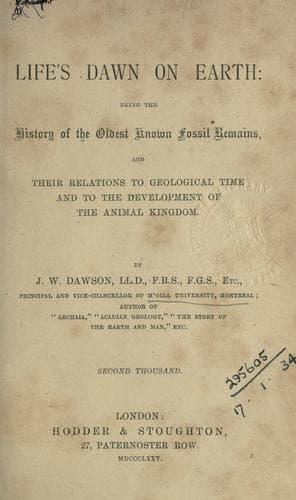
Life's Dawn on Earth: Being the history of the oldest known fossil remains, and their relations to geological time and to the development of the animal kingdomDawson, John William, Sir
History
Life's Dawn on Earth: Being the history of the oldest known fossil remains, and their relations to geological time and to the development of the animal kingdom
Dawson, John William, Sir
Life -- Origin; Paleontology -- Precambrian
tubuli, will be found as well preserved as in any of the specimens
from Côte St. Pierre.
"It was the general form on weathered surfaces, and its strong
resemblance to Stromatopora, which first attracted my attention to
Eozoon; and the persistence of it in two distinct minerals, pyroxene
and loganite, emboldened me, in 1857, to place before the Meeting of
the American Association for the Advancement of Science specimens of
it as probably a Laurentian fossil. After that, the form was found
preserved in a third mineral, serpentine; and in one of the previous
specimens it was then observed to pass continuously through two
of the minerals, pyroxene and serpentine. Now we have it imbedded
in limestone, just as most fossils are. In every case, with the
exception of the Burgess specimens, the general form is composed of
carbonate of lime; and we have good grounds for supposing it was
originally so in the Burgess specimens also. If, therefore, with such
evidence, and without the minute structure, I was, upon a calculation
of chances, disposed, in 1857, to look upon the form as organic, much
more must I so regard it when the chances have been so much augmented
by the subsequent accumulation of evidence of the same kind, and
the addition of the minute structure, as described by Dr. Dawson,
whose observations have been confirmed and added to by the highest
British authority upon the class of animals to which the form has
been referred, leaving in my mind no room whatever for doubt of its
organic character. Objections to it as an organism have been made by
Professors King and Rowney: but these appear to me to be based upon
the supposition that because some parts simulating organic structure
are undoubtedly mere mineral arrangement, therefore all parts are
mineral. Dr. Dawson has not proceeded upon the opposite supposition,
that because some parts are, in his opinion, undoubtedly organic,
therefore all parts simulating organic structure are organic; but
he has carefully distinguished between the mineral and organic
arrangements. I am aware, from having supplied him with a vast number
of specimens prepared for the microscope by the lapidary of the
Canadian Survey, from a series of rocks of Silurian and Huronian,
as well as Laurentian age, and from having followed the course of
his investigation as it proceeded, that nearly all the points of
objection of Messrs. King and Rowney passed in review before him
prior to his coming to the conclusions which he has published."
_Ascending Section of the Eozoic Rocks in the County of Hastings,
Ontario._ By Mr. H. G. Vennor.
Feet.
1. Reddish and flesh-coloured granitic gneiss, the thickness
of which is unknown; estimated at not less than 2,000
Public-domain text, read in full here on John Shaqi.
Reviews
Reviews
No reviews yet
Be the first to share your thoughts on this work.
Join the Discussion
Join the discussion
Sign in to leave a comment or review.
Sign InorCreate an account