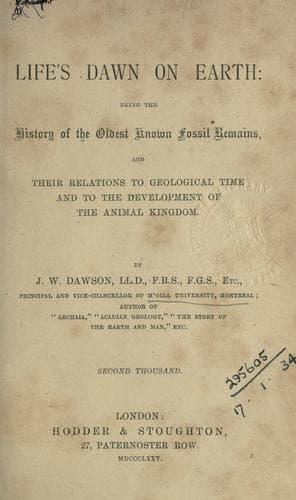
Life's Dawn on Earth: Being the history of the oldest known fossil remains, and their relations to geological time and to the development of the animal kingdomDawson, John William, Sir
History
Life's Dawn on Earth: Being the history of the oldest known fossil remains, and their relations to geological time and to the development of the animal kingdom
Dawson, John William, Sir
Life -- Origin; Paleontology -- Precambrian
"Specimens from Long Lake, in the collection of the Geological
Survey of Canada, exhibit white crystalline limestone with light
green compact or septariiform[W] serpentine, and much resemble some
of the serpentine limestones of Grenville. Under the microscope the
calcareous matter presents a delicate areolated appearance, without
lamination; but it is not an example of acervuline Eozoon, but rather
of fragments of such a structure, confusedly aggregated together, and
having the interstices and cell-cavities filled with serpentine. I
have not found in any of these fragments a canal system similar to
that of Eozoon Canadense, though there are casts of large stolons,
and, under a high power, the calcareous matter shows in many places
the peculiar granular or cellular appearance which is one of the
characters of the supplemental skeleton of that species. In a few
places a tubulated cell-wall is preserved, with structure similar to
that of Eozoon Canadense.
[Footnote W: I use the term "septariiform" to denote the _curdled_
appearance so often presented by the Laurentian serpentine.]
"Specimens of Laurentian limestone from Wentworth, in the collection
of the Geological Survey, exhibit many rounded silicious bodies, some
of which are apparently grains of sand, or small pebbles; but others,
especially when freed from the calcareous matter by a dilute acid,
appear as rounded bodies, with rough surfaces, either separate or
aggregated in lines or groups, and having minute vermicular processes
projecting from their surfaces. At first sight these suggest the
idea of spicules; but I think it on the whole more likely that
they are casts of cavities and tubes belonging to some calcareous
Foraminiferal organism which has disappeared. Similar bodies, found
in the limestone of Bavaria, have been described by Gümbel, who
interprets them in the same way. They may also be compared with the
silicious bodies mentioned in a former paper as occurring in the
loganite filling the chambers of specimens of _Eozoon_ from Burgess."
These specimens will be more fully referred to under Chapter VI.
(D.) Additional Structural Facts.
Public-domain text, read in full here on John Shaqi.
Reviews
Reviews
No reviews yet
Be the first to share your thoughts on this work.
Elsewhere in the archive
Join the Discussion
Join the discussion
Sign in to leave a comment or review.
Sign InorCreate an account