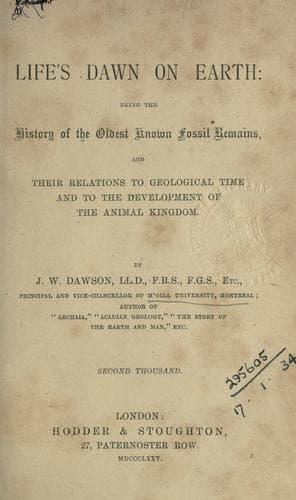
Life's Dawn on Earth: Being the history of the oldest known fossil remains, and their relations to geological time and to the development of the animal kingdomDawson, John William, Sir
History
Life's Dawn on Earth: Being the history of the oldest known fossil remains, and their relations to geological time and to the development of the animal kingdom
Dawson, John William, Sir
Life -- Origin; Paleontology -- Precambrian
However this may be, the infiltration of the pores of Eozoon with
serpentine and other silicates has evidently been one main means of
the preservation of its structure. When so infiltrated no metamorphism
short of the complete fusion of the containing rock could obliterate
the minutest points of structure; and that such fusion has not
occurred, the preservation in the Laurentian rocks of the most delicate
lamination of the beds shows conclusively; while, as already stated, it
can be shown that the alteration which has occurred might have taken
place at a temperature far short of that necessary to fuse limestone.
Thus has it happened that these most ancient fossils have been
handed down to our time in a state of preservation comparable, as Dr.
Carpenter states, to that of the best preserved fossil Foraminifera
from the more recent formations that have come under his observation in
the course of all his long experience.
Let us now look more minutely at the nature of the typical specimens
of Eozoon as originally observed and described, and then turn to those
preserved in other ways, or more or less destroyed and defaced. Taking
a polished specimen from Petite Nation, like that delineated in Plate
V., we find the shell represented by white limestone, and the chambers
by light green serpentine. By acting on the surface with a dilute
acid we etch out the calcareous part, leaving a cast in serpentine
of the cavities occupied by the soft parts; and when this is done in
polished slices these may be made to print their own characters on
paper, as has actually been done in the case of Plate V., which is an
electrotype taken from an actual specimen, and shows both the laminated
and acervuline parts of the fossil. If the process of decalcification
has been carefully executed, we find in the excavated spaces delicate
ramifying processes of opaque serpentine or transparent dolomite, which
were originally imbedded in the calcareous substance, and which are
often of extreme fineness and complexity. (Plate VI. and fig. 10.)
These are casts of the canals which traversed the shell when still
inhabited by the animal. In some well preserved specimens we find the
original cell-wall represented by a delicate white film, which under
the microscope shows minute needle-like parallel processes representing
its still finer tubuli. It is evident that to have filled these tubuli
the serpentine must have been introduced in a state of actual solution,
and must have carried with it no foreign impurities. Consequently we
find that in the chambers themselves the serpentine is pure; and if we
examine it under polarized light, we see that it presents a singularly
curdled or irregularly laminated appearance, which I have designated
under the name septariiform, as if it had an imperfectly crystalline
structure, and had been deposited in irregular laminæ, beginning at
the sides of the chambers, and filling them toward the middle, and
Public-domain text, read in full here on John Shaqi.
Reviews
Reviews
No reviews yet
Be the first to share your thoughts on this work.
Elsewhere in the archive
Join the Discussion
Join the discussion
Sign in to leave a comment or review.
Sign InorCreate an account