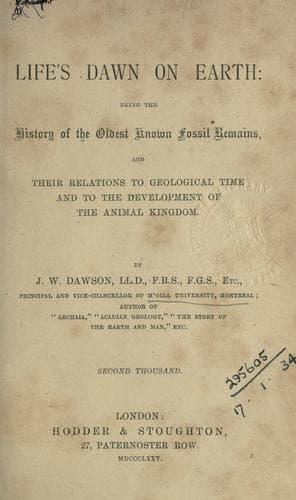
Life's Dawn on Earth: Being the history of the oldest known fossil remains, and their relations to geological time and to the development of the animal kingdomDawson, John William, Sir
History
Life's Dawn on Earth: Being the history of the oldest known fossil remains, and their relations to geological time and to the development of the animal kingdom
Dawson, John William, Sir
Life -- Origin; Paleontology -- Precambrian
Every worker in those applications of the microscope to geological
specimens which have been termed micro-geology, is familiar with the
fact that crystalline forces and mechanical movements of material
often play the most fantastic tricks with fossilized organic matter.
In fossil woods, for example, we often have the tissues disorganized,
with radiating crystallizations of calcite and little spherical
concretions of quartz, or disseminated cubes and grains of pyrite,
or little veins filled with sulphate of barium or other minerals. We
need not, therefore, be surprised to find that in the venerable rocks
containing Eozoon, such things occur in the more highly crystalline
parts of the limestones, and even in some still showing traces of
the fossil. We find many disseminated crystals of magnetite, pyrite,
spinel, mica, and other minerals, curiously curved prisms of vermicular
mica, bundles of aciculi of tremolite and similar substances, veins of
calcite and crysolite or fibrous serpentine, which often traverse the
best specimens. Where these occur abundantly we usually find no organic
structures remaining, or if they exist they are in a very defective
state of preservation. Even in specimens presenting the lamination of
Eozoon to the naked eye, these crystalline actions have often destroyed
the minute structure; and I fear that some microscopists have been
victimised by having under their consideration only specimens in which
the actual characters had been too much defaced to be discernible. I
must here state that I have found some of the specimens sold under
the name of Eozoon Canadense by dealers in microscopical objects to
be almost or quite worthless, being destitute of any good structure,
and often merely pieces of Laurentian limestone with serpentine
grains only. I fear that the circulation of such specimens has done
much to cause scepticism as to the Foraminiferal nature of Eozoon. No
mistake can be greater than to suppose that any and every specimen
of Laurentian limestone must contain Eozoon. More especially have
I hitherto failed to detect traces of it in those carbonaceous or
graphitic limestones which are so very abundant in the Laurentian
country. Perhaps where vegetable matter was very abundant Eozoon
did not thrive, or on the other hand the growth of Eozoon may have
diminished the quantity of vegetable matter. It is also to be observed
that much compression and distortion have occurred in the beds of
Laurentian limestone and their contained fossils, and also that the
specimens are often broken by faults, some of which are so small as to
appear only on microscopic examination, and to shift the plates of the
fossil just as if they were beds of rock. This, though it sometimes
produces puzzling appearances, is an evidence that the fossils were
hard and brittle when this faulting took place, and is consequently
an additional proof of their extraneous origin. In some specimens it
Public-domain text, read in full here on John Shaqi.
Reviews
Reviews
No reviews yet
Be the first to share your thoughts on this work.
Elsewhere in the archive
Join the Discussion
Join the discussion
Sign in to leave a comment or review.
Sign InorCreate an account