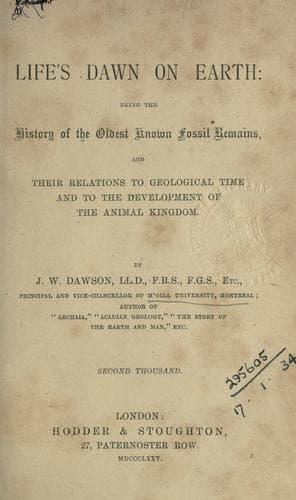
Life's Dawn on Earth: Being the history of the oldest known fossil remains, and their relations to geological time and to the development of the animal kingdomDawson, John William, Sir
History
Life's Dawn on Earth: Being the history of the oldest known fossil remains, and their relations to geological time and to the development of the animal kingdom
Dawson, John William, Sir
Life -- Origin; Paleontology -- Precambrian
would seem that the lower and older part of the fossil had been wholly
converted into serpentine or pyroxene, or had so nearly experienced
this change that only small parts of the calcareous wall can be
recognised. These portions correspond with fossil woods altogether
silicified, not only by the filling of the cells, but also by the
conversion of the walls into silica. I have specimens which manifestly
show the transition from the ordinary condition of filling with
serpentine to one in which the cell-walls are represented obscurely by
one shade of this mineral and the cavities by another.
The above considerations as to mode of preservation of Eozoon concur
with those in previous chapters in showing its oceanic character;
but the ocean of the Eozoic period may not have been so deep as at
present, and its waters were probably warm and well stocked with
mineral matters derived from the newly formed land, or from hot springs
in its own bottom. On this point the interesting investigations of
Dr. Hunt with reference to the chemical conditions of the Silurian
seas, allow us to suppose that the Laurentian ocean may have been much
more richly stored, more especially with salts of lime and magnesia,
than that of subsequent times. Hence the conditions of warmth, light,
and nutriment, required by such gigantic Protozoans would all be
present, and hence, also no doubt, some of the peculiarities of its
mineralization.
NOTES TO CHAPTER V.
(A.) Dr. Sterry Hunt on the Mineralogy of Eozoon and the containing
Rocks.
It was fortunate for the recognition of Eozoon that Dr. Hunt had,
before its discovery, made so thorough researches into the chemistry
of the Laurentian series, and was prepared to show the chemical
possibilities of the preservation of fossils in these ancient
deposits. The following able summary of his views was appended to the
original description of the fossil in the _Journal of the Geological
Society_.
Public-domain text, read in full here on John Shaqi.
Reviews
Reviews
No reviews yet
Be the first to share your thoughts on this work.
Elsewhere in the archive
Join the Discussion
Join the discussion
Sign in to leave a comment or review.
Sign InorCreate an account