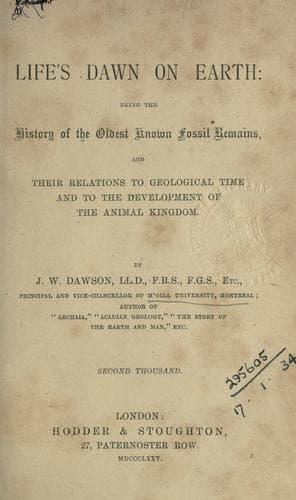
Life's Dawn on Earth: Being the history of the oldest known fossil remains, and their relations to geological time and to the development of the animal kingdomDawson, John William, Sir
History
Life's Dawn on Earth: Being the history of the oldest known fossil remains, and their relations to geological time and to the development of the animal kingdom
Dawson, John William, Sir
Life -- Origin; Paleontology -- Precambrian
"The details of structure have been preserved by the introduction
of certain mineral silicates, which have not only filled up the
chambers, cells, and canals left vacant by the disappearance of the
animal matter, but have in very many cases been injected into the
tubuli, filling even their smallest ramifications. These silicates
have thus taken the place of the original sarcode, while the
calcareous septa remain. It will then be understood that when the
replacement of the Eozoon by silicates is spoken of, this is to be
understood of the soft parts only; since the calcareous skeleton is
preserved, in most cases, without any alteration. The vacant spaces
left by the decay of the sarcode may be supposed to have been filled
by a process of infiltration, in which the silicates were deposited
from solution in water, like the silica which fills up the pores of
wood in the process of silicification. The replacing silicates, so
far as yet observed, are a white pyroxene, a pale green serpentine,
and a dark green alumino-magnesian mineral, which is allied in
composition to chlorite and to pyrosclerite, and which I have
referred to loganite. The calcareous septa in the last case are found
to be dolomitic, but in the other instances are nearly pure carbonate
of lime. The relations of the carbonate and the silicates are well
seen in thin sections under the microscope, especially by polarized
light. The calcite, dolomite, and pyroxene exhibit their crystalline
structure to the unaided eye; and the serpentine and loganite are
also seen to be crystalline when examined with the microscope. When
portions of the fossil are submitted to the action of an acid, the
carbonate of lime is dissolved, and a coherent mass of serpentine is
obtained, which is a perfect cast of the soft parts of the Eozoon.
The form of the sarcode which filled the chambers and cells is
beautifully shown, as well as the connecting canals and the groups
of tubuli; these latter are seen in great perfection upon surfaces
from which the carbonate of lime has been partially dissolved. Their
preservation is generally most complete when the replacing mineral is
serpentine, although very perfect specimens are sometimes found in
pyroxene. The crystallization of the latter mineral appears, however,
in most cases to have disturbed the calcareous septa.
Public-domain text, read in full here on John Shaqi.
Reviews
Reviews
No reviews yet
Be the first to share your thoughts on this work.
Elsewhere in the archive
Join the Discussion
Join the discussion
Sign in to leave a comment or review.
Sign InorCreate an account