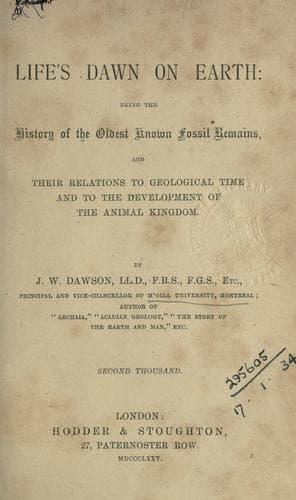
Life's Dawn on Earth: Being the history of the oldest known fossil remains, and their relations to geological time and to the development of the animal kingdomDawson, John William, Sir
History
Life's Dawn on Earth: Being the history of the oldest known fossil remains, and their relations to geological time and to the development of the animal kingdom
Dawson, John William, Sir
Life -- Origin; Paleontology -- Precambrian
"Serpentine and pyroxene are generally associated in these specimens,
as if their disposition had marked different stages of a continuous
process. At the Calumet, one specimen of the fossil exhibits the
whole of the sarcode replaced by serpentine; while, in another one
from the same locality, a layer of pale green translucent serpentine
occurs in immediate contact with the white pyroxene. The calcareous
septa in this specimen are very thin, and are transverse to the plane
of contact of the two minerals; yet they are seen to traverse both
the pyroxene and the serpentine without any interruption or change.
Some sections exhibit these two minerals filling adjacent cells,
or even portions of the same cell, a clear line of division being
visible between them. In the specimens from Grenville on the other
hand, it would seem as if the development of the Eozoon (considerable
masses of which were replaced by pyroxene) had been interrupted, and
that a second growth of the animal, which was replaced by serpentine,
had taken place upon the older masses, filling up their interstices."
[Details of chemical composition are then given.]
"When examined under the microscope, the loganite which replaces the
Eozoon of Burgess shows traces of cleavage-lines, which indicate a
crystalline structure. The grains of insoluble matter found in the
analysis, chiefly of quartz-sand, are distinctly seen as foreign
bodies imbedded in the mass, which is moreover marked by lines
apparently due to cracks formed by a shrinking of the silicate, and
subsequently filled by a further infiltration of the same material.
This arrangement resembles on a minute scale that of septaria.
Similar appearances are also observed in the serpentine which
replaces the Eozoon of Grenville, and also in a massive serpentine
from Burgess, resembling this, and enclosing fragments of the fossil.
In both of these specimens also grains of mechanical impurities are
detected by the microscope; they are however, rarer than in the
loganite of Burgess.
Public-domain text, read in full here on John Shaqi.
Reviews
Reviews
No reviews yet
Be the first to share your thoughts on this work.
Elsewhere in the archive
Join the Discussion
Join the discussion
Sign in to leave a comment or review.
Sign InorCreate an account