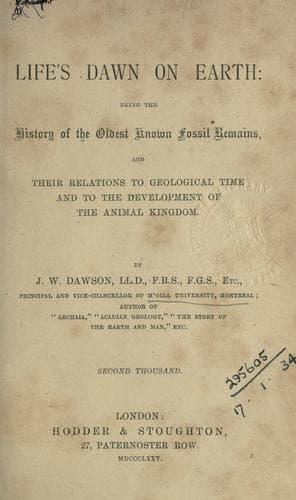
Life's Dawn on Earth: Being the history of the oldest known fossil remains, and their relations to geological time and to the development of the animal kingdomDawson, John William, Sir
History
Life's Dawn on Earth: Being the history of the oldest known fossil remains, and their relations to geological time and to the development of the animal kingdom
Dawson, John William, Sir
Life -- Origin; Paleontology -- Precambrian
"From the above facts it may be concluded that the various silicates
which now constitute pyroxene, serpentine, and loganite were directly
deposited in waters in the midst of which the Eozoon was still
growing, or had only recently perished; and that these silicates
penetrated, enclosed, and preserved the calcareous structure
precisely as carbonate of lime might have done. The association
of the silicates with the Eozoon is only accidental; and large
quantities of them, deposited at the same time, include no organic
remains. Thus, for example, there are found associated with the
Eozoon limestones of Grenville, massive layers and concretions of
pure serpentine; and a serpentine from Burgess has already been
mentioned as containing only small broken fragments of the fossil.
In like manner large masses of white pyroxene, often surrounded
by serpentine, both of which are destitute of traces of organic
structure, are found in the limestone at the Calumet. In some cases,
however, the crystallization of the pyroxene has given rise to
considerable cleavage-planes, and has thus obliterated the organic
structures from masses which, judging from portions visible here and
there, appear to have been at one time penetrated by the calcareous
plates of Eozoon. Small irregular veins of crystalline calcite, and
of serpentine, are found to traverse such pyroxene masses in the
Eozoon limestone of Grenville.
"It appears that great beds of the Laurentian limestones are
composed of the ruins of the Eozoon. These rocks, which are white,
crystalline, and mingled with pale green serpentine, are similar in
aspect to many of the so-called primary limestones of other regions.
In most cases the limestones are non-magnesian, but one of them
from Grenville was found to be dolomitic. The accompanying strata
often present finely crystallized pyroxene, hornblende, phlogopite,
apatite, and other minerals. These observations bring the formation
of silicious minerals face to face with life, and show that their
generation was not incompatible with the contemporaneous existence
and the preservation of organic forms. They confirm, moreover, the
view which I some years since put forward, that these silicated
minerals have been formed, not by subsequent metamorphism in
deeply buried sediments, but by reactions going on at the earth's
surface.[Z] In support of this view, I have elsewhere referred to
the deposition of silicates of lime, magnesia, and iron from natural
waters, to the great beds of sepiolite in the unaltered Tertiary
strata of Europe; to the contemporaneous formation of neolite (an
aluimino-magnesian silicate related to loganite and chlorite in
composition); and to glauconite, which occurs not only in Secondary,
Tertiary, and Recent deposits, but also, as I have shown, in Lower
Silurian strata.[AA] This hydrous silicate of protoxide of iron
Public-domain text, read in full here on John Shaqi.
Reviews
Reviews
No reviews yet
Be the first to share your thoughts on this work.
Elsewhere in the archive
Join the Discussion
Join the discussion
Sign in to leave a comment or review.
Sign InorCreate an account