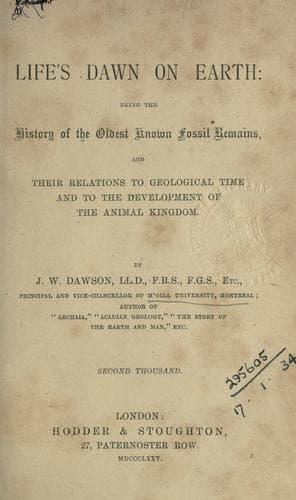
Life's Dawn on Earth: Being the history of the oldest known fossil remains, and their relations to geological time and to the development of the animal kingdomDawson, John William, Sir
History
Life's Dawn on Earth: Being the history of the oldest known fossil remains, and their relations to geological time and to the development of the animal kingdom
Dawson, John William, Sir
Life -- Origin; Paleontology -- Precambrian
and potash, which sometimes includes a considerable proportion of
alumina in its composition, has been observed by Ehrenberg, Mantell,
and Bailey, associated with organic forms in a manner which seems
identical with that in which pyroxene, serpentine, and loganite
occur with the Eozoon in the Laurentian limestones. According to the
first of these observers, the grains of green-sand, or glauconite,
from the Tertiary limestone of Alabama, are casts of the interior
of Polythalamia, the glauconite having filled them by 'a species of
natural injection, which is often so perfect that not only the large
and coarse cells, but also the very finest canals of the cell-walls
and all their connecting tubes, are thus petrified and separately
exhibited.' Bailey confirmed these observations, and extended them.
He found in various Cretaceous and Tertiary limestones of the United
States, casts in glauconite, not only of _Foraminifera_, but of
spines of _Echinus_, and of the cavities of corals. Besides, there
were numerous red, green, and white casts of minute anastomosing
tubuli, which, according to Bailey, resemble the casts of the holes
made by burrowing sponges (_Cliona_) and worms. These forms are seen
after the dissolving of the carbonate of lime by a dilute acid.
He found, moreover, similar casts of _Foraminifera_, of minute
mollusks, and of branching tubuli, in mud obtained from soundings in
the Gulf Stream, and concluded that the deposition of glauconite is
still going on in the depths of the sea.[AB] Pourtales has followed
up these investigations on the recent formation of glauconite in
the Gulf Stream waters. He has observed its deposition also in
the cavities of _Millepores_, and in the canals in the shells
of _Balanus_. According to him, the glauconite grains formed in
_Foraminifera_ lose after a time their calcareous envelopes, and
finally become 'conglomerated into small black pebbles,' sections
of which still show under a microscope the characteristic spiral
arrangement of the cells.[AC]
[Footnote Z: _Silliman's Journal_ [2], xxix., p. 284; xxxii., p. 286.
_Geology of Canada_, p. 577.]
[Footnote AA: _Silliman's Journal_ [2], xxxiii., p. 277. _Geology of
Canada_, p. 487.]
[Footnote AB: _Silliman's Journal_ [2], xxii., p. 280.]
[Footnote AC: _Report of United States Coast-Survey_, 1858, p. 248.]
Public-domain text, read in full here on John Shaqi.
Reviews
Reviews
No reviews yet
Be the first to share your thoughts on this work.
Elsewhere in the archive
Join the Discussion
Join the discussion
Sign in to leave a comment or review.
Sign InorCreate an account