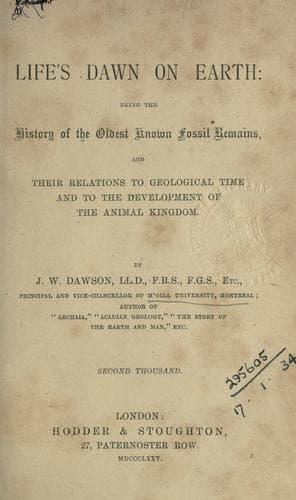
Life's Dawn on Earth: Being the history of the oldest known fossil remains, and their relations to geological time and to the development of the animal kingdomDawson, John William, Sir
History
Life's Dawn on Earth: Being the history of the oldest known fossil remains, and their relations to geological time and to the development of the animal kingdom
Dawson, John William, Sir
Life -- Origin; Paleontology -- Precambrian
"It appears probable from these observations that glauconite is
formed by chemical reactions in the ooze at the bottom of the sea,
where dissolved silica comes in contact with iron oxide rendered
soluble by organic matter; the resulting silicate deposits itself in
the cavities of shells and other vacant spaces. A process analogous
to this in its results, has filled the chambers and canals of the
Laurentian _Foraminifera_ with other silicates; from the comparative
rarity of mechanical impurities in these silicates, however, it would
appear that they were deposited in clear water. Alumina and oxide of
iron enter into the composition of loganite as well as of glauconite;
but in the other replacing minerals, pyroxene and serpentine, we
have only silicates of lime and magnesia, which were probably formed
by the direct action of alkaline silicates, either dissolved in
surface-waters, or in those of submarine springs, upon the calcareous
and magnesian salts of the sea-water."
[As stated in the text, the canals of Eozoon are sometimes filled
with dolomite, or in part with serpentine and in part with dolomite.]
(B.) Silurian Limestones holding Fossils infiltrated with Hydrous
Silicate.
Since my attention has been directed to this subject, many
illustrations have come under my notice of Silurian limestones in
which the pores of fossils are infiltrated with hydrous silicates
akin to glauconite and serpentine. A limestone of this kind,
collected by Mr. Robb, at Pole Hill, in New Brunswick, afforded not
only beautiful specimens of portions of Crinoids preserved in this
way, but a sufficient quantity of the material was collected for an
exact analysis, a note on which was published in the Proceedings of
the Royal Irish Academy, 1871.
Public-domain text, read in full here on John Shaqi.
Reviews
Reviews
No reviews yet
Be the first to share your thoughts on this work.
Elsewhere in the archive
Join the Discussion
Join the discussion
Sign in to leave a comment or review.
Sign InorCreate an account