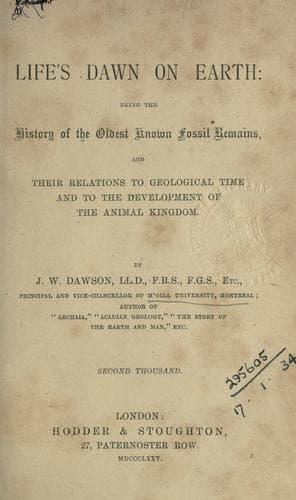
Life's Dawn on Earth: Being the history of the oldest known fossil remains, and their relations to geological time and to the development of the animal kingdomDawson, John William, Sir
History
Life's Dawn on Earth: Being the history of the oldest known fossil remains, and their relations to geological time and to the development of the animal kingdom
Dawson, John William, Sir
Life -- Origin; Paleontology -- Precambrian
The limestone of Pole Hill is composed almost wholly of organic
fragments, cemented by crystalline carbonate of lime, and traversed
by slender veins of the same mineral. Among the fragments may be
recognised under the microscope portions of Trilobites, and of
brachiopod and gastropod shells, and numerous joints and plates
of Crinoids. The latter are remarkable for the manner in which
their reticulated structure, which is similar to that of modern
Crinoids, has been injected with a silicious substance, which is
seen distinctly in slices, and still more plainly in decalcified
specimens. This filling is precisely similar in appearance to the
serpentine filling the canals of Eozoon, the only apparent difference
being in the forms of the cells and tubes of the Crinoids, as
compared with those of the Laurentian fossil; the same silicious
substance also occupies the cavities of some of the small shells,
and occurs in mere amorphous pieces, apparently filling interstices.
From its mode of occurrence, I have not the slightest doubt that
it occupied the cavities of the crinoidal fragments while still
recent, and before they had been cemented together by the calcareous
paste. This silicious filling is therefore similar on the one hand
to that effected by the ancient serpentine of the Laurentian, and
on the other to that which results from the depositions of modern
glauconite. The analysis of Dr. Hunt, which I give below, fully
confirms these analogies.
I may add that I have examined under the microscope portions of the
substance prepared by Dr. Hunt for analysis, and find it to retain
its form, showing that it is the actual filling of the cavities. I
have also examined the small amount of insoluble silica remaining
after his treatment with acid and alkaline solvents, and find it to
consist of angular and rounded grains of quartzose sand.
The following are Dr. Hunt's notes:--
Public-domain text, read in full here on John Shaqi.
Reviews
Reviews
No reviews yet
Be the first to share your thoughts on this work.
Elsewhere in the archive
Join the Discussion
Join the discussion
Sign in to leave a comment or review.
Sign InorCreate an account