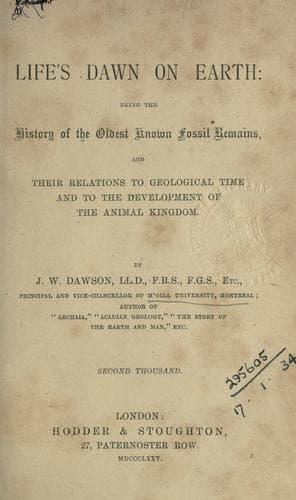
Life's Dawn on Earth: Being the history of the oldest known fossil remains, and their relations to geological time and to the development of the animal kingdomDawson, John William, Sir
History
Life's Dawn on Earth: Being the history of the oldest known fossil remains, and their relations to geological time and to the development of the animal kingdom
Dawson, John William, Sir
Life -- Origin; Paleontology -- Precambrian
"The fossiliferous limestone from Pole Hill, New Brunswick, probably
of Upper Silurian age, is light gray and coarsely granular. When
treated with dilute hydrochloric acid, it leaves a residue of 5·9 per
cent., and the solution gives 1·8 per cent. of alumina and oxide of
iron, and magnesia equal to 1·35 of carbonate--the remainder being
carbonate of lime. The insoluble matter separated by dilute acid,
after washing by decantation from a small amount of fine flocculent
matter, consists, apart from an admixture of quartz grains, entirely
of casts and moulded forms of a peculiar silicate, which Dr. Dawson
has observed in decalcified specimens filling the pores of crinoidal
stems; and which when separated by an acid, resembles closely under
the microscope the coralloidal forms of arragonite known as _flos
ferri_, the surfaces being somewhat rugose and glistening with
crystalline faces. This silicate is sub-translucent, and of a pale
green colour, but immediately becomes of a light reddish brown when
heated to redness in the air, and gives off water when heated in a
tube, without however, changing its form. It is partially decomposed
by strong hydrochloric acid, yielding a considerable amount of
protosalt of iron. Strong hot sulphuric acid readily and completely
decomposes it, showing it to be a silicate of alumina and ferrous
oxide, with some magnesia and alkalies, but with no trace of lime.
The separated silica, which remains after the action of the acid,
is readily dissolved by a dilute solution of soda, leaving behind
nothing but angular and partially rounded grains of sand, chiefly
of colourless vitreous quartz. An analysis effected in the way just
described on 1·187 grammes gave the following results, which give, by
calculation, the centesimal composition of the mineral:--
Silica ·3290 38·93 = 20·77 oxygen·
Alumina ·2440 28·88 = 13·46 "
Protoxyd of iron ·1593 18·86}
Magnesia ·0360 4·25} = 6·29 "
Potash ·0140 1·69}
Soda ·0042 ·48}
Water ·0584 6·91 = 6·14 "
Insoluble, quartz ·3420
------ ------
1·1869 100·00
"A previous analysis of a portion of the mixture by fusion with
carbonate of soda gave, by calculation, 18·80 p. c. of protoxide of
iron, and amounts of alumina and combined silica closely agreeing
with those just given.
Public-domain text, read in full here on John Shaqi.
Reviews
Reviews
No reviews yet
Be the first to share your thoughts on this work.
Elsewhere in the archive
Join the Discussion
Join the discussion
Sign in to leave a comment or review.
Sign InorCreate an account