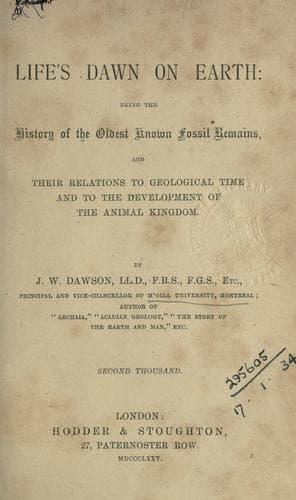
Life's Dawn on Earth: Being the history of the oldest known fossil remains, and their relations to geological time and to the development of the animal kingdomDawson, John William, Sir
History
Life's Dawn on Earth: Being the history of the oldest known fossil remains, and their relations to geological time and to the development of the animal kingdom
Dawson, John William, Sir
Life -- Origin; Paleontology -- Precambrian
"The oxygen ratios, as above calculated, are nearly as 3 : 2 : 1 : 1.
This mineral approaches in composition to the jollyte of Von Kobell,
from which it differs in containing a portion of alkalies, and only
one half as much water. In these respects it agrees nearly with the
silicate found by Robert Hoffman, at Raspenau, in Bohemia, where it
occurs in thin layers alternating with picrosmine, and surrounding
masses of Eozoon in the Laurentian limestones of that region;[AD]
the Eozoon itself being there injected with a hydrous silicate which
may be described as intermediate between glauconite and chlorite in
composition. The mineral first mentioned is compared by Hoffman to
fahlunite, to which jollyte is also related in physical characters as
well as in composition. Under the names of fahlunite, gigantolite,
pinite, etc., are included a great class of hydrous silicates, which
from their imperfectly crystalline condition, have generally been
regarded, like serpentine, as results of the alteration of other
silicates. It is, however, difficult to admit that the silicate
found in the condition described by Hoffman, and still more the
present mineral, which injects the pores of palæozoic Crinoids, can
be any other than an original deposition, allied in the mode of its
formation, to the serpentine, pyroxene, and other minerals which have
injected the Laurentian Eozoon, and the serpentine and glauconite,
which in a similar manner fill Tertiary and recent shells."
[Footnote AD: _Journ. für Prakt. Chemie_, Bd. 106 (Erster Jahrgang,
1869), p. 356.]
(C.) Various Minerals filling Cavities of Fossils in the Laurentian.
The following on this subject is from a memoir by Dr. Hunt in the
_Twenty-first Report of the Regents of the University of New York_,
1874:--
"Recent investigations have shown that in some cases the
dissemination of certain of these minerals through the crystalline
limestones is connected with organic forms. The observations
of Dr. Dawson and myself on the Eozoon Canadense showed that
certain silicates, namely serpentine, pyroxene, and loganite,
had been deposited in the cells and chambers left vacant by the
disappearance of the animal matter from the calcareous skeleton of
the foraminiferous organism; so that when this calcareous portion is
removed by an acid there remains a coherent mass, which is a cast of
the soft parts of the animal, in which, not only the chambers and
connecting canals, but the minute tubuli and pores are represented
by solid mineral silicates. It was shown that this process must have
taken place immediately after the death of the animal, and must have
depended on the deposition of these silicates from the waters of the
ocean.
Public-domain text, read in full here on John Shaqi.
Reviews
Reviews
No reviews yet
Be the first to share your thoughts on this work.
Elsewhere in the archive
Join the Discussion
Join the discussion
Sign in to leave a comment or review.
Sign InorCreate an account