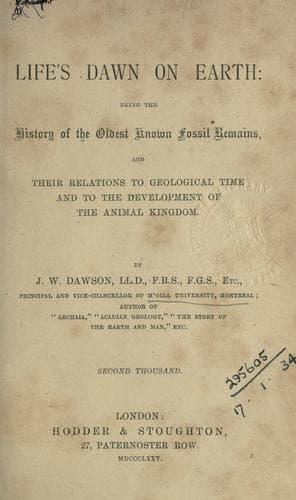
Life's Dawn on Earth: Being the history of the oldest known fossil remains, and their relations to geological time and to the development of the animal kingdomDawson, John William, Sir
History
Life's Dawn on Earth: Being the history of the oldest known fossil remains, and their relations to geological time and to the development of the animal kingdom
Dawson, John William, Sir
Life -- Origin; Paleontology -- Precambrian
"The train of investigation thus opened up, has been pursued by
Dr. Gümbel, Director of the Geological Survey of Bavaria, who, in
a recent remarkable memoir presented to the Royal Society of that
country, has detailed his results.
"Having first detected a fossil identical with the Canadian Eozoon
(together with several other curious microscopic organic forms not
yet observed in Canada), replaced by serpentine in a crystalline
limestone from the primitive group of Bavaria, which he identified
with the Laurentian system of this country, he next discovered a
related organism, to which he has given the name of Eozoon Bavaricum.
This occurs in a crystalline limestone belonging to a series of rocks
more recent than the Laurentian, but older than the Primordial zone
of the Lower Silurian, and designated by him the Hercynian clay slate
series, which he conceives may represent the Cambrian system of Great
Britain, and perhaps correspond to the Huronian series of Canada and
the United States. The cast of the soft parts of this new fossil is,
according to Gümbel, in part of serpentine, and in part of hornblende.
"His attention was next directed to the green hornblende (pargasite)
which occurs in the crystalline limestone of Pargas in Finland, and
remains when the carbonate of lime is dissolved as a coherent mass
closely resembling that left by the irregular and acervuline forms
of Eozoon. The calcite walls also sometimes show casts of tubuli....
A white mineral, probably scapolite was found to constitute some
tubercles associated with the pargasite, and the two mineral species
were in some cases united in the same rounded grain.
"Similar observations were made by him upon specimens of coccolite
or green pyroxene, occurring in rounded and wrinkled grains in a
Laurentian limestone from New York. These, according to Gümbel,
present the same connecting cylinders and branching stems as the
pargasite, and are by him supposed to have been moulded in the
same manner.... Very beautiful evidences of the same organic
structure consisting of the casts of tubuli and their ramifications,
were also observed by Gümbel in a purely crystalline limestone,
enclosing granules of chondrodite, hornblende, and garnet, from
Boden in Saxony. Other specimens of limestone, both with and without
serpentine and chondrodite, were examined without exhibiting any
traces of these peculiar forms; and these negative results are
justly deemed by Gümbel as going to prove that the structure of
the others is really, like that of Eozoon, the result of the
intervention of organic forms. Besides the minerals observed in the
replacing substance of Eozoon in Canada, viz., serpentine, pyroxene,
and loganite, Gümbel adds chondrodite, hornblende, scapolite, and
probably also pyrallolite, quartz, iolite, and dichroite."
(D.) Glauconites.
Public-domain text, read in full here on John Shaqi.
Reviews
Reviews
No reviews yet
Be the first to share your thoughts on this work.
Elsewhere in the archive
Join the Discussion
Join the discussion
Sign in to leave a comment or review.
Sign InorCreate an account