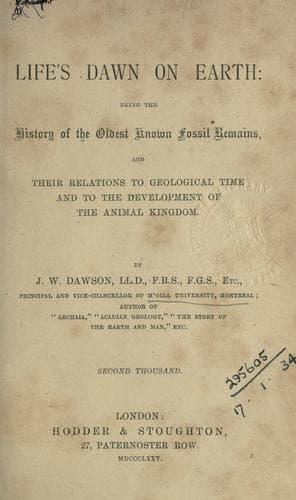
Life's Dawn on Earth: Being the history of the oldest known fossil remains, and their relations to geological time and to the development of the animal kingdomDawson, John William, Sir
History
Life's Dawn on Earth: Being the history of the oldest known fossil remains, and their relations to geological time and to the development of the animal kingdom
Dawson, John William, Sir
Life -- Origin; Paleontology -- Precambrian
The following is from a paper by Dr. Hunt in the _Report of the
Survey of Canada_ for 1866:--
"In connection with the Eozoon it is interesting to examine more
carefully into the nature of the matters which have been called
glauconite or green-sand. These names have been given to substances
of unlike composition, which, however, occur under similar
conditions, and appear to be chemical deposits from water, filling
cavities in minute fossils, or forming grains in sedimentary rocks
of various ages. Although greenish in colour, and soft and earthy
in texture, it will be seen that the various glauconites differ
widely in composition. The variety best known, and commonly regarded
as the type of the glauconites, is that found in the green-sand of
Cretaceous age in New Jersey, and in the Tertiary of Alabama; the
glauconite from the Lower Silurian rocks of the Upper Mississippi is
identical with it in composition. Analysis shows these glauconites to
be essentially hydrous silicates of protoxyd of iron, with more or
less alumina, and small but variable quantities of magnesia, besides
a notable amount of potash. This alkali is, however, sometimes
wanting, as appears from the analysis of a green-sand from Kent in
England, by that careful chemist, the late Dr. Edward Turner, and
in another examined by Berthier, from the _calcaire grossier_, near
Paris, which is essentially a serpentine in composition, being a
hydrous silicate of magnesia and protoxyd of iron. A comparison of
these last two will show that the loganite, which fills the ancient
Foraminifer of Burgess, is a silicate nearly related in composition.
I. Green-sand from the _calcaire grossier_, near Paris. Berthier
(cited by Beudant, _Mineralogie_, ii., 178).
II. Green-sand from Kent, England. Dr. Edward Turner (cited by
Rogers, Final Report, Geol. N. Jersey, page 206).
III. Loganite from the Eozoon of Burgess.
IV. Green-sand, Lower Silurian; Red Bird, Minnesota.
V. Green-sand, Cretaceous, New Jersey.
VI. Green-sand, Lower Silurian, Orleans Island.
The last four analyses are by myself.
I. II. III. IV. V. VI.
Silica 40·0 48·5 35·14 46·58 50·70 50·7
Protoxyd of iron 24·7 22·0 8·60 20·61 22·50 8·6
Magnesia 16·6 3·8 31·47 1·27 2·16 3·7
Lime 3·3 .... .... 2·49 1·11 ....
Alumina 1·7 17·0 10·15 11·45 8·03 19·8
Potash .... traces. .... 6·96 5·80 8·2
Soda .... .... .... ·98 ·75 ·5
Water 12·6 7·0 14·64 9·66 8·95 8·5
---- ---- ------ ------ ------ -----
98·9 98·3 100·00 100·00 100·00 100·0"
[Illustration:
Plate VI.
From a Photo. by Weston. Vincent Brooks, Day & Son Lith.
CANAL SYSTEM OF EOZOON.
Public-domain text, read in full here on John Shaqi.
Reviews
Reviews
No reviews yet
Be the first to share your thoughts on this work.
Elsewhere in the archive
Join the Discussion
Join the discussion
Sign in to leave a comment or review.
Sign InorCreate an account