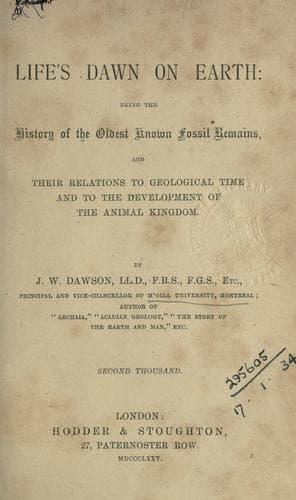
Life's Dawn on Earth: Being the history of the oldest known fossil remains, and their relations to geological time and to the development of the animal kingdomDawson, John William, Sir
History
Life's Dawn on Earth: Being the history of the oldest known fossil remains, and their relations to geological time and to the development of the animal kingdom
Dawson, John William, Sir
Life -- Origin; Paleontology -- Precambrian
SLICES OF THE FOSSIL (MAGNIFIED.)
_To face Chap. 6._]
CHAPTER VI.
CONTEMPORARIES AND SUCCESSORS OF EOZOON.
The name Eozoon, or Dawn-animal, raises the question whether we shall
ever know any earlier representative of animal life. Here I think
it necessary to explain that in suggesting the name Eozoon for the
earliest fossil, and Eozoic for the formation in which it is contained,
I had no intention to affirm that there may not have been precursors
of the Dawn-animal. By the similar term, Eocene, Lyell did not mean
to affirm that there may not have been modern types in the preceding
geological periods: and so the dawn of animal life may have had its
gray or rosy breaking at a time long anterior to that in which Eozoon
built its marble reefs. When the fossils of this early auroral time
shall be found, it will not be hard to invent appropriate names for
them. There are, however, two reasons that give propriety to the
name in the present state of our knowledge. One is, that the Lower
Laurentian rocks are absolutely the oldest that have yet come under
the notice of geologists, and at the present moment it seems extremely
improbable that any older sediments exist, at least in a condition to
be recognised as such. The other is that Eozoon, as a member of the
group Protozoa, of gigantic size and comprehensive type, and oceanic in
its habitat, is as likely as any other creature that can be imagined
to have been the first representative of animal life on our planet.
Vegetable life may have preceded it, nay probably did so by at least
one great creative æon, and may have accumulated previous stores of
organic matter; but if any older forms of animal life existed, it is
certain at least that they cannot have belonged to much simpler or more
comprehensive types. It is also to be observed that such forms of life,
if they did exist, may have been naked protozoa, which may have left no
sign of their existence except a minute trace of carbonaceous matter,
and perhaps not even this.
Public-domain text, read in full here on John Shaqi.
Reviews
Reviews
No reviews yet
Be the first to share your thoughts on this work.
Elsewhere in the archive
Join the Discussion
Join the discussion
Sign in to leave a comment or review.
Sign InorCreate an account