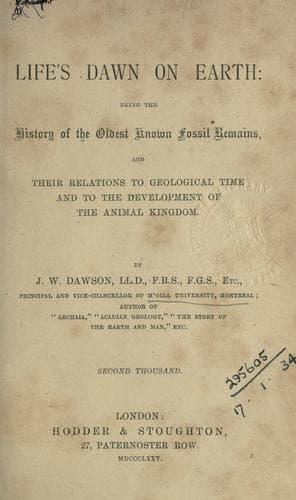
Life's Dawn on Earth: Being the history of the oldest known fossil remains, and their relations to geological time and to the development of the animal kingdomDawson, John William, Sir
History
Life's Dawn on Earth: Being the history of the oldest known fossil remains, and their relations to geological time and to the development of the animal kingdom
Dawson, John William, Sir
Life -- Origin; Paleontology -- Precambrian
But if we do not know, and perhaps we are not likely to know, any
animals older than Eozoon, may we not find traces of some of its
contemporaries, either in the Eozoon limestones themselves, or other
rocks associated with them? Here we must admit that a deep sea
Foraminiferal limestone may give a very imperfect indication of the
fauna of its time. A dredger who should have no other information as
to the existing population of the world, except what he could gather
from the deposits formed under several hundred fathoms of water, would
necessarily have very inadequate conceptions of the matter. In like
manner a geologist who should have no other information as to the
animal life of the Mesozoic ages than that furnished by some of the
thick beds of white chalk might imagine that he had reached a period
when the simplest kinds of protozoa predominated over all other
forms of life; but this impression would at once be corrected by the
examination of other deposits of the same age: so our inferences as to
the life of the Laurentian from the contents of its oceanic limestones
may be very imperfect, and it may yet yield other and various fossils.
Its possibilities are, however, limited by the fact that before we
reach this great depth in the earth's crust, we have already left
behind in much newer formations all traces of animal life except a
few of the lower forms of aquatic invertebrates; so that we are not
surprised to find only a limited number of living things, and those of
very low type. Do we then know in the Laurentian even a few distinct
species, or is our view limited altogether to Eozoon Canadense? In
answering this question we must bear in mind that the Laurentian itself
was of vast duration, and that important changes of life may have taken
place even between the deposition of the Eozoon limestones and that
of those rocks in which we find the comparatively rich fauna of the
Primordial age. This subject was discussed by the writer as early as
1865, and I may repeat here what could be said in relation to it at
that time:--
"In connection with these remarkable remains, it appeared desirable to
ascertain, if possible, what share these or other organic structures
may have had in the accumulation of the limestones of the Laurentian
series. Specimens were therefore selected by Sir W. E. Logan, and
slices were prepared under his direction. On microscopic examination,
a number of these were found to exhibit merely a granular aggregation
of crystals, occasionally with particles of graphite and other foreign
minerals, or a laminated mixture of calcareous and other matters, in
the manner of some more modern sedimentary limestones. Others, however,
were evidently made up almost entirely of fragments of Eozoon, or of
mixtures of these with other calcareous and carbonaceous fragments
which afford more or less evidence of organic origin. The contents of
these organic limestones may be considered under the following heads:--
1. Remains of Eozoon.
Public-domain text, read in full here on John Shaqi.
Reviews
Reviews
No reviews yet
Be the first to share your thoughts on this work.
Elsewhere in the archive
Join the Discussion
Join the discussion
Sign in to leave a comment or review.
Sign InorCreate an account