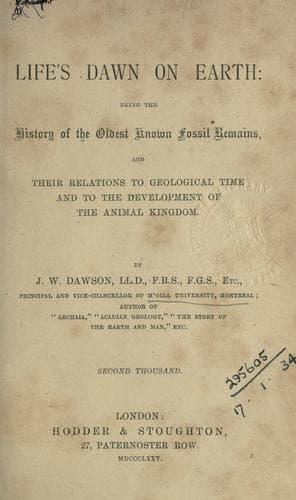
Life's Dawn on Earth: Being the history of the oldest known fossil remains, and their relations to geological time and to the development of the animal kingdomDawson, John William, Sir
History
Life's Dawn on Earth: Being the history of the oldest known fossil remains, and their relations to geological time and to the development of the animal kingdom
Dawson, John William, Sir
Life -- Origin; Paleontology -- Precambrian
2. Other calcareous bodies, probably organic.
3. Objects imbedded in the serpentine.
4. Carbonaceous matters.
5. Perforations, or worm-burrows.
"1. The more perfect specimens of Eozoon do not constitute the mass
of any of the larger specimens in the collection of the Survey; but
considerable portions of some of them are made up of material of
similar minute structure, destitute of lamination, and irregularly
arranged. Some of this material gives the impression that there may
have been organisms similar to Eozoon, but growing in an irregular
or acervuline manner without lamination. Of this, however, I cannot
be certain; and on the other hand there is distinct evidence of the
aggregation of fragments of Eozoon in some of these specimens. In
some they constitute the greater part of the mass. In others they
are embedded in calcareous matter of a different character, or in
serpentine or granular pyroxene. In most of the specimens the cells of
the fossils are more or less filled with these minerals; and in some
instances it would appear that the calcareous matter of fragments of
Eozoon has been in part replaced by serpentine."
"2. Intermixed with the fragments of Eozoon above referred to, are
other calcareous matters apparently fragmentary. They are of various
angular and rounded forms, and present several kinds of structure. The
most frequent of these is a strong lamination varying in direction
according to the position of the fragments, but corresponding, as
far as can be ascertained, with the diagonal of the rhombohedral
cleavage. This structure, though crystalline, is highly characteristic
of crinoidal remains when preserved in altered limestones. The more
dense parts of Eozoon, destitute of tubuli, also sometimes show this
structure, though less distinctly. Other fragments are compact and
structureless, or show only a fine granular appearance; and these
sometimes include grains, patches, or fibres of graphite. In Silurian
limestones, fragments of corals and shells which have been partially
infiltrated with bituminous matter, show a structure like this. On
comparison with altered organic limestones of the Silurian system,
these appearances would indicate that in addition to the debris of
Eozoon, other calcareous structures, more like those of crinoids,
corals, and shells, have contributed to the formation of the
Laurentian limestones.
Public-domain text, read in full here on John Shaqi.
Reviews
Reviews
No reviews yet
Be the first to share your thoughts on this work.
Elsewhere in the archive
Join the Discussion
Join the discussion
Sign in to leave a comment or review.
Sign InorCreate an account