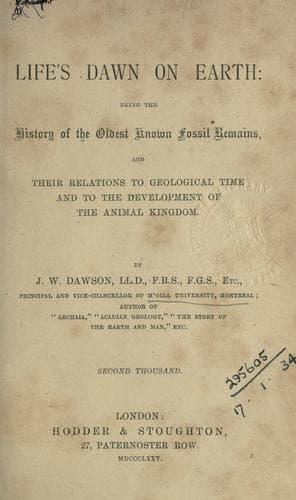
Life's Dawn on Earth: Being the history of the oldest known fossil remains, and their relations to geological time and to the development of the animal kingdomDawson, John William, Sir
History
Life's Dawn on Earth: Being the history of the oldest known fossil remains, and their relations to geological time and to the development of the animal kingdom
Dawson, John William, Sir
Life -- Origin; Paleontology -- Precambrian
"3. In the serpentine[AE] filling the chambers of a large specimen of
Eozoon from Burgess, there are numerous small pieces of foreign matter;
and the silicate itself is laminated, indicating its sedimentary
nature. Some of the included fragments appear to be carbonaceous,
others calcareous; but no distinct organic structure can be detected
in them. There are, however, in the serpentine, many minute silicious
grains of a bright green colour, resembling green-sand concretions;
and the manner in which these are occasionally arranged in lines and
groups, suggests the supposition that they may possibly be casts of
the interior of minute Foraminiferal shells. They may, however, be
concretionary in their origin.
[Footnote AE: This is the dark green mineral named loganite by Dr.
Hunt.]
"4. In some of the Laurentian limestones submitted to me by Sir W.
E. Logan, and in others which I collected some years ago at Madoc,
Canada West, there are fibres and granules of carbonaceous matter,
which do not conform to the crystalline structure, and present forms
quite similar to those which in more modern limestones result from
the decomposition of algæ. Though retaining mere traces of organic
structure, no doubt would be entertained as to their vegetable origin
if they were found in fossiliferous limestones.
"5. A specimen of impure limestone from Madoc, in the collection of
the Canadian Geological Survey, which seems from its structure to
have been a finely laminated sediment, shows perforations of various
sizes, somewhat scalloped at the sides, and filled with grains of
rounded silicious sand. In my own collection there are specimens
of micaceous slate from the same region, with indications on their
weathered surfaces of similar rounded perforations, having the aspect
of Scolithus, or of worm-burrows.
Public-domain text, read in full here on John Shaqi.
Reviews
Reviews
No reviews yet
Be the first to share your thoughts on this work.
Elsewhere in the archive
Join the Discussion
Join the discussion
Sign in to leave a comment or review.
Sign InorCreate an account