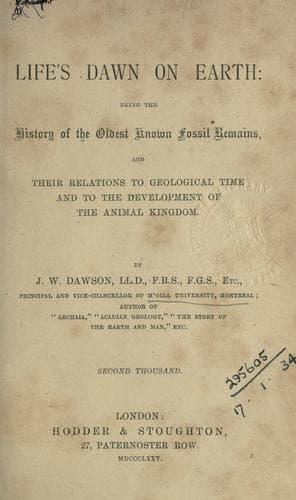
Life's Dawn on Earth: Being the history of the oldest known fossil remains, and their relations to geological time and to the development of the animal kingdomDawson, John William, Sir
History
Life's Dawn on Earth: Being the history of the oldest known fossil remains, and their relations to geological time and to the development of the animal kingdom
Dawson, John William, Sir
Life -- Origin; Paleontology -- Precambrian
"Though the abundance and wide distribution of Eozoon, and the
important part it seems to have acted in the accumulation of limestone,
indicate that it was one of the most prevalent forms of animal
existence in the seas of the Laurentian period, the non-existence of
other organic beings is not implied. On the contrary, independently of
the indications afforded by the limestones themselves, it is evident
that in order to the existence and growth of these large Rhizopods, the
waters must have swarmed with more minute animal or vegetable organisms
on which they could subsist. On the other hand, though this is a less
certain inference, the dense calcareous skeleton of Eozoon may indicate
that it also was liable to the attacks of animal enemies. It is also
possible that the growth of Eozoon, or the deposition of the serpentine
and pyroxene in which its remains have been preserved, or both, may
have been connected with certain oceanic depths and conditions, and
that we have as yet revealed to us the life of only certain stations
in the Laurentian seas. Whatever conjectures we may form on these more
problematic points, the observations above detailed appear to establish
the following conclusions:--
"First, that in the Laurentian period, as in subsequent geological
epochs, the Rhizopods were important agents in the accumulation of
beds of limestone; and secondly, that in this early period these low
forms of animal life attained to a development, in point of magnitude
and complexity, unexampled, in so far as yet known, in the succeeding
ages of the earth's history. This early culmination of the Rhizopods is
in accordance with one of the great laws of the succession of living
beings, ascertained from the study of the introduction and progress of
other groups; and, should it prove that these great Protozoans were
really the dominant type of animals in the Laurentian period, this fact
might be regarded as an indication that in these ancient rocks we may
actually have the records of the first appearance of animal life on our
planet."
Public-domain text, read in full here on John Shaqi.
Reviews
Reviews
No reviews yet
Be the first to share your thoughts on this work.
Elsewhere in the archive
Join the Discussion
Join the discussion
Sign in to leave a comment or review.
Sign InorCreate an account