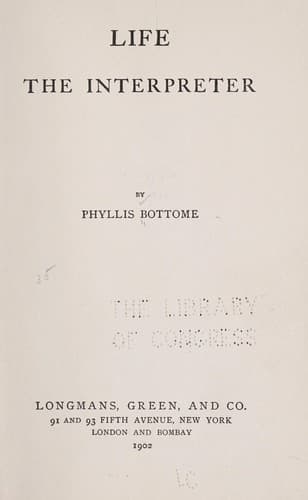
East End (London, England) -- Fiction; London (England) -- Social conditions -- Fiction; Social settlements -- Fiction
When the door closed firmly after him limits seemed to dissolve. She put
the fan down carefully on the table, and she looked at her miserable
face in the glass with a vague, ulterior satisfaction, for even if one’s
heart was broken it was something of a comfort that one looked
distinctly pretty in tears.
CHAPTER VII
“So long as we know not what it opens, nothing can be more
beautiful than a key.”
THE short June days soon came to an end, and Muriel found them none too
short, for warmth can only be enjoyed by the luxurious, and her life at
present was anything but that.
If one plunged into the work and life of the people it needed strength
both of will and body to carry one through its disillusions.
There was nothing in the least exciting in the work before her—it was
merely very hard. Occasionally it was true the great opportunity would
arise, as it had done in the case of poor Liz. But next to their
extraordinary infrequency came the swiftness with which all the
greatness evaporated: their very sins were so matter-of-fact, and the
larger elements in life were taken so unpicturesquely that they seemed
shorn of their solemnity, and then strangely robbed of all “the trailing
clouds” of mystery. When a widow spoke of her dead husband as “’E made a
beautiful corpse, ’e did—yer ought to er seen ’im, miss,” the word died
on her lips, and to look at a dead baby as being “one less mouth to
feed,” jarred on all her tender notes of sympathy by the crudity of its
truth.
Muriel wrote to Gladys, who, strange to say, had come to see her alone,
not once but often, that she had never known “death could be vulgar
before;” and, though she felt very worried at the thought of shutting up
the club for three months, she confessed to herself her heart rose at
the thought of the long, easy luxury of house-parties, country days, and
even a glimpse of the sea. People, too, who said a little more—and
meant a little less—she looked forward to meeting with a positive sense
of rest. Clear black and white were rather glaring she thought, and how
life was mellowed by a little mist! Jack Hurstly had never been to see
her. She had heard of him occasionally from Gladys.
Sir Arthur wished her to come at once to Blacklands, a house in a
beautiful vicinity, not too far from the conveniences of life; and
towards the end of July, very tired and fagged, Muriel packed up her
things to go. There were many good-byes to be said, but they were all
over now with the exception of Liz—Liz and the baby. She had not seen
either of them lately. As she knocked at the door she heard the long,
fretful wail of a sick child, and then the ungracious tones of a woman’s
voice.
“Ah, it’s you, is it?” she added shrilly as Muriel entered. “I thought
you had given us the slip. No, I ain’t been comin’ to the club, nor I
don’t mean to—nor Dick neither, we ’ave ’ad enough of it, we ’ave.”
Public-domain text, read in full here on John Shaqi.
Reviews
Reviews
No reviews yet
Be the first to share your thoughts on this work.
Join the Discussion
Join the discussion
Sign in to leave a comment or review.
Sign InorCreate an account