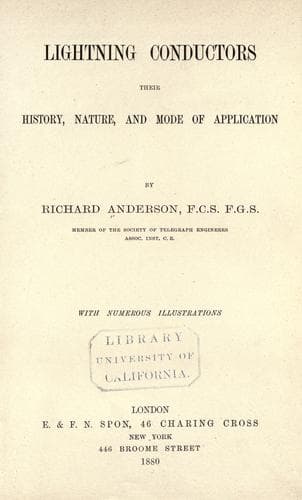
Lightning Conductors: Their History, Nature, and Mode of ApplicationAnderson, Richard, F.C.S.
History
Lightning Conductors: Their History, Nature, and Mode of Application
Anderson, Richard, F.C.S.
Lightning conductors
Prof. Clerk Maxwell, in a letter to Mr. Charles Tomlinson, F.R.S., the
author of ‘The Thunderstorm,’ says: ‘My plan is to convert a building
into a closed conducting vessel by a sufficient number of wires
enclosing it. For an ordinary house, a skeleton of its edge is quite
enough. A _a_ may be a zinc ridge, B _b_ and C _c_ water-gutters of
zinc or iron; but the pieces A B D, A C E, _a b d_, _a c e_, and the
circuit D E _e d_ should be of stout copper wire or rope, built into
the wall as a security against theft, but connected to every other
piece of metal on the outer surface of the house, and to every gas or
water-pipe which enters the house from without, but _not_ to any masses
of metal wholly within the whole, unless this is desirable for other
purposes.’
[Illustration: Fig. 39.]
CHAPTER XIV.
ACCIDENTS AND FATALITIES FROM LIGHTNING.
The accidents that occur annually from the effects of lightning are
far greater in number and extent than is generally supposed. Although
the art of protecting buildings by means of lightning conductors was
discovered some hundred and twenty-seven years ago, and it is now one
hundred and eleven years since, in 1768, Benjamin Franklin’s ‘lightning
rods’ were first set up over the dome of Saint Paul’s Cathedral, yet
the application of this great discovery is by no means general. At
least one-half, and perhaps two-thirds, of all the public buildings,
including the churches and chapels, of Great Britain and Ireland,
are without any protection against lightning. As to private houses,
it may safely be affirmed that not five out of every thousand are
fitted with lightning conductors. It is well known that the amount of
property annually destroyed by lightning in this country is very great,
though it is, very naturally, impossible to form any accurate, or even
approximate estimate of it. With regard, however, to the number of
deaths from the same cause, certain statistics do exist, although many
of them are notoriously imperfect. According to the ‘Fortieth Report of
the Registrar-General,’ issued in July 1878, and former reports, the
number of deaths from lightning in England and Wales was as follows in
each of the nine years from 1869 to 1877:—
+--------+-------+---------+-------+
| Years | Males | Females | Total |
+--------+-------+---------+-------+
| 1869 | 5 | 2 | 7 |
| 1870 | 13 | 6 | 19 |
| 1871 | 23 | 5 | 28 |
| 1872 | 35 | 11 | 46 |
| 1873 | 17 | 4 | 21 |
| 1874 | 25 | — | 25 |
| 1875 | 14 | 3 | 17 |
| 1876 | 15 | 4 | 19 |
| 1877 | — | — | 12 |
+--------+-------+---------+-------+
| Total | 147 | 35 | 194 |
+--------+-------+---------+-------+
Public-domain text, read in full here on John Shaqi.
Reviews
Reviews
No reviews yet
Be the first to share your thoughts on this work.
Elsewhere in the archive
Join the Discussion
Join the discussion
Sign in to leave a comment or review.
Sign InorCreate an account