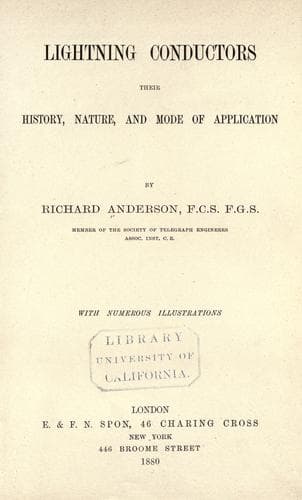
Lightning Conductors: Their History, Nature, and Mode of Application — John Shaqi
Lightning Conductors: Their History, Nature, and Mode of ApplicationAnderson, Richard, F.C.S.
History
Lightning Conductors: Their History, Nature, and Mode of Application
Anderson, Richard, F.C.S.
Lightning conductors
The identity of the electric force and lightning, vaguely surmised
by previous inquirers, and expressed at times in hints, was not only
firmly asserted by Benjamin Franklin, but at a comparatively early part
of his investigations proved by him in experiments. His broad practical
way of looking at facts succeeded in grasping a truth which all the
learned men before him, who had busied themselves with electrical
experiments, had not been able to lay hold of, simply because they lost
themselves in philosophical abstractions. The professors sought the
unattainable, and he confined himself strictly to what he considered
within reach, and it was thus he gained his end.
The thoroughly matter-of-fact way in which Franklin went to work
is strikingly exhibited in his own description as to how he came
to the conclusion of the oneness of lightning and electricity. In
reply to a friend and correspondent, living in South Carolina, who
had asked him how he came to such an ‘out-of-the-way idea’ as that
of the majestic fire from the cloud-capped firmament being exactly
the same with the puny gleam from a stick of glass, rubbed with the
sleeve of an old coat, Franklin wrote a highly characteristic letter.
‘I cannot answer your question better,’ he told his friend, ‘than
by giving you an extract from the minutes I used to keep of the
experiments I made. By this extract you will see that the thought was
not so much an out-of-the-way one but that it might have occurred to
any electrician. The extract, dated November 7, 1749--a date worth
remembrance in the history of scientific progress--was as follows
in its entirety:—‘Electrical fluid agrees with lightning, in these
particulars: 1. Giving light. 2. The colour of the light. 3. In the
crooked direction of the flame. 4. In the swift motion. 5. In being
conducted by metals. 6. In the crack, or noise, of the explosion. 7.
The subsisting in water, or ice. 8. In the rending of bodies it passes
through. 9. In destroying animals. 10. In melting metals. 11. In firing
inflammable substances. 12. The sulphurous smell. The electric fluid
is attracted by points, and we do not know whether this property is in
lightning. But since they agree in all the particulars wherein we can
already compare them, is it not probable that they agree likewise in
this? _Let the experiment be made._’
CHAPTER II.
DISCOVERY OF THE LIGHTNING CONDUCTOR.
Public-domain text, read in full here on John Shaqi.
Reviews
Reviews
No reviews yet
Be the first to share your thoughts on this work.
Join the Discussion
Join the discussion
Sign in to leave a comment or review.
Sign InorCreate an account