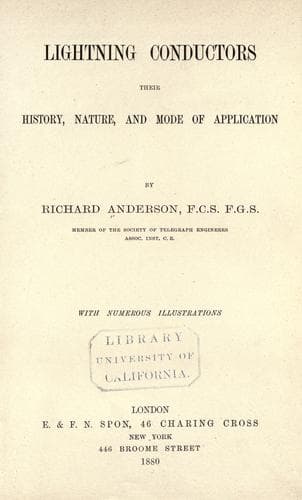
Lightning Conductors: Their History, Nature, and Mode of Application — John Shaqi
Lightning Conductors: Their History, Nature, and Mode of ApplicationAnderson, Richard, F.C.S.
History
Lightning Conductors: Their History, Nature, and Mode of Application
Anderson, Richard, F.C.S.
Lightning conductors
With that liberality which distinguishes all truly great minds,
Benjamin Franklin did not keep his great discoveries to himself,
but communicated them to others in the most open-handed manner.
Ever since he had commenced his electrical experiments, he had sent
the detailed results of them to his London correspondent, Mr. Peter
Collinson, for communication to the Royal Society, and he was not
even prevented from continuing the labour of writing long letters by
the knowledge of the fact that scant notice was taken of them by the
Royal Society. The members of this august learned body, with a few
honourable exceptions, seemed unable to hide their contempt for what
they considered the dabblings in science of a mere tradesman, living
in an obscure little town, in a distant colony. Somebody had mentioned
in public that this person, of the name of Franklin, was a dealer in
rags and goose-feathers, dwelling among money-worshipping Quakers in
the City of Brotherly Love: which naturally was productive of great
merriment, but detrimental to scientific respect. Thus, although by the
influence of Mr. Collinson and some of his friends, the letters from
Philadelphia were read before the Royal Society, they met with scarcely
any attention, and the members broadly expressed their disdain of them
by refusing to allow their insertion in their ‘Transactions.’ Three
whole years elapsed in this way, when at length, in the autumn of 1750,
Benjamin Franklin reported to Mr. Collinson his researches on the
identity of electricity and lightning, together with his ideas that all
damage done by the electric fire descending from the clouds upon the
earth might be put a stop to by fixing iron rods, with sharp points, to
the summit of buildings, which would thus be protected. He added that
he himself intended shortly to verify his conclusions by experiments,
but that, in the meanwhile, it would be well if others did the same.
Never before, perhaps, was a grand idea thrown out to all the world
with more munificence of spirit, and with more entire abnegation of the
very thought of self.
Public-domain text, read in full here on John Shaqi.
Reviews
Reviews
No reviews yet
Be the first to share your thoughts on this work.
Join the Discussion
Join the discussion
Sign in to leave a comment or review.
Sign InorCreate an account