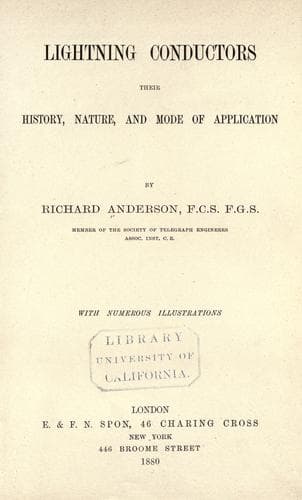
Lightning Conductors: Their History, Nature, and Mode of ApplicationAnderson, Richard, F.C.S.
History
Lightning Conductors: Their History, Nature, and Mode of Application
Anderson, Richard, F.C.S.
Lightning conductors
Hemmer not only wrote a number of little books, which
he liberally distributed, but travelled about through many parts of
Germany, instigating the authorities to place conductors on all public
buildings, and the people to set them up over their own houses. Holding
that the earth connection was everything, he advocated simply to dig
a hole in the ground till water or very moist earth was reached, and
to stick a small iron bar, wrapped in lead to prevent rust, into it,
running up the roof. The bar any village blacksmith could forge, and
the hole any man or boy could dig, thus making the absolute cost of the
conductor under this arrangement very trifling. Dr. Hemmer was right,
no doubt, in his main argument, and most successful in spreading the
knowledge of lightning conductors, while he was able to boast that not
one of all the number he had set up had ever failed. However, he lived
in an age when as yet water and gas pipes were unknown, and iron, or
any other metal, scarcely entered into the construction of buildings.
Given a leaden roof and a network of metal tubes, and Dr. Hemmer’s
small iron rod could scarcely be expected to do its work of protection.
Together with Dr. Hemmer in Germany, Professor Landriani, of Milan,
drew attention to the paramount importance of a perfect earth
connection. He made it his special business to investigate cases in
which buildings with lightning conductors had been struck, and was able
to show in nearly every instance that it had been for want of ‘good
earth.’ A very striking case, which ought to have brought conviction
of the truth to all investigators of the subject, occurred in Genoa in
1779. The church of St. Mary in this city, standing in a very elevated
position, had been frequently struck by lightning, sometimes as often
as twice in one year, and it was noticed that the electric force always
followed precisely the same path, running along a certain portion
of masonry, partly secured by iron hoops, and finally demolishing a
wall at the bottom to get into the earth. At last, in November 1778,
a conductor, made of the most approved design, was placed over the
church, but, to the great surprise of the scientific men who had
superintended the work, the lightning fell once more upon the building
in the month of July of the following year, again following the old
path it had constantly taken before, and causing absolutely the same
damage as previously, even to the knocking out of certain portions of
the wall nearest the ground. Naturally, the event caused widespread
interest, leading to the closest examination of the church of St. Mary
by several experts, among them Professor Landriani. He had no great
trouble in discovering both the causes of the path of the lightning
having always been the same when falling upon the church, and of the
edifice having been struck again in the same manner when provided with
a lightning conductor. Being a somewhat peculiar structure, consisting
Public-domain text, read in full here on John Shaqi.
Reviews
Reviews
No reviews yet
Be the first to share your thoughts on this work.
Elsewhere in the archive
Join the Discussion
Join the discussion
Sign in to leave a comment or review.
Sign InorCreate an account