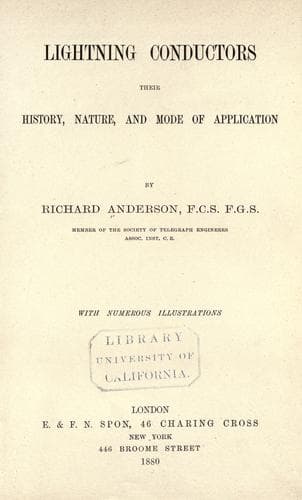
Lightning Conductors: Their History, Nature, and Mode of ApplicationAnderson, Richard, F.C.S.
History
Lightning Conductors: Their History, Nature, and Mode of Application
Anderson, Richard, F.C.S.
Lightning conductors
in part of hewn stones held together with iron cramps, there was a
large quantity of metal both in and outside; and it was found that
the path of the lightning had always been precisely in the direction
where the metal offered the greatest continuity, leaping over the short
intervals that existed by destroying the stone, and finally getting
into the ground to a place where there was always a collection of
water by knocking down a wall. If this accounted satisfactorily for
the former accidents, that which took place when a conductor had been
placed was not much more difficult of explanation. Professor Landriani
found that though the conductor itself was very good, it was useless
simply by having its roots in hard rock instead of moist ground. On
the one side of St. Mary’s Church there was a rill of water rippling
down from the hills, and forming a small pool near the church, while
on the other was the hard rock. It was into a crevice of the latter
that the conductor had been laid, thus leaving the electric force to
seek its old path into the water along the iron bars, which, although
disjointed, formed a far better road to earth than the planned road.
It was a convincing proof of the supreme necessity of a good earth
connection. Still, a long time yet was to elapse before conviction
became general.
Probably, the matter was more studied by Italian scientific men than
any others, the study of electricity having always been a favourite
pursuit in that country; yet there, too, the matter was not understood
till quite recently. This is proved by a letter of the celebrated
astronomer and meteorologist, Father Secchi, addressed to the French
scientific journal ‘Les Mondes,’ in October 1872, in which he tells
the story of an accident that befel a building protected by lightning
conductors set up under his own direction, the earth connection being
made after rules laid down by Professor Matteucci, considered the
leading authority on the subject. The letter of Father Secchi, though
of some length, is given here entirely, both on account of the great
fame of the writer, but recently deceased, and because it throws a
flood of light on some of the most important points connected with the
art of designing and applying lightning conductors.
‘Eight years ago,’ says Father Secchi, writing, as just mentioned, in
1872, ‘some lightning conductors had been erected under my direction
on the cathedral and on the Bishop’s palace of Alatri, situated at
the summit of the Acropolis of that town, which, by its elevated and
solitary position, was exposed to frequent ravages from storms. It was
not long ago that a flash of lightning demolished a great part of the
belfry, and damaged the organ of the church. In the erection of this
lightning conductor there arose a great difficulty proceeding from the
nature of the soil, which at the depth of some centimetres turns out to
be entirely of solid calcareous rock.
Public-domain text, read in full here on John Shaqi.
Reviews
Reviews
No reviews yet
Be the first to share your thoughts on this work.
Elsewhere in the archive
Join the Discussion
Join the discussion
Sign in to leave a comment or review.
Sign InorCreate an account