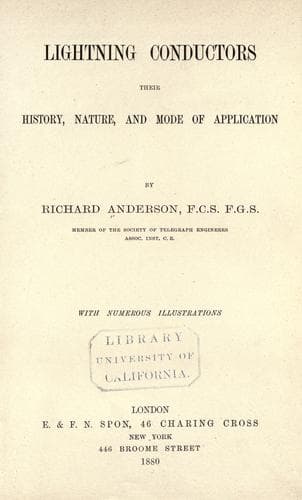
Lightning Conductors: Their History, Nature, and Mode of ApplicationAnderson, Richard, F.C.S.
History
Lightning Conductors: Their History, Nature, and Mode of Application
Anderson, Richard, F.C.S.
Lightning conductors
The first actual lightning conductor ever constructed was set up by
Benjamin Franklin himself, at his house in Philadelphia. Its main
object was to protect the house against the effects of thunderstorms;
still experiments were so dear to the heart of the great discoverer,
that he could not help making trials even with things devoted to other
uses. It was in the summer of 1752 that Franklin erected over his house
a lightning conductor, made entirely of iron, but with a sharp steel
point on the top, the latter projecting seven or eight feet above the
roof, while the end was above five feet in the ground. Curious to know
whenever an electrical stream was passing through the conductor, he
attached to it an ingenious contrivance, by means of which through
an electric spark two bells were set in movement as soon as this
took place, the greater or lesser noise from them corresponding with
the strength of the electrical current. With the aid of this device
Franklin was enabled to observe some curious phenomena, which at first
puzzled him not a little. ‘I found the bells rang sometimes,’ he
informed a friend, ‘when there was no lightning or thunder, but only a
dark cloud over the rod; that sometimes, after a flash of lightning,
they would suddenly stop, and at other times, when they had not rung
before, they would, after a flash, suddenly begin to ring; that the
electricity was sometimes very faint, so that when a small spark was
obtained, another could not be got for some time after. At other
times, the sparks would follow extremely quickly; and once I had a
continual stream from bell to bell, the size of a crow-quill. Even
during the same gust there were considerable variations.’ By continued
watching, Franklin came to make the discovery that the fluctuations
in the electrical current were owing to changes and interchanges,
in atmosphere and earth, of positive and negative electricity. He
held at first that thunder-clouds are usually in a negative state of
electricity, but afterwards discovered that they varied from negative
to positive during the same storm.
Public-domain text, read in full here on John Shaqi.
Reviews
Reviews
No reviews yet
Be the first to share your thoughts on this work.
Join the Discussion
Join the discussion
Sign in to leave a comment or review.
Sign InorCreate an account