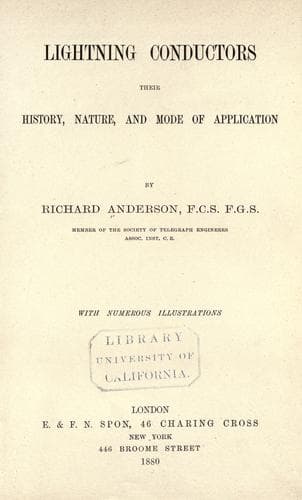
Lightning Conductors: Their History, Nature, and Mode of ApplicationAnderson, Richard, F.C.S.
History
Lightning Conductors: Their History, Nature, and Mode of Application
Anderson, Richard, F.C.S.
Lightning conductors
Notwithstanding the unbounded praises bestowed upon Benjamin Franklin
for the great discovery of the lightning conductor, the actual
adaptation of it spread with extreme slowness. It was in the country
of its origin that it was brought into public use, all the countries
of Europe lagging far behind. But even in the Northern States of
America, though inhabited by a highly intelligent race, there were
great difficulties to overcome. The ministers of religion at first
seemed to think that the iron rods were not altogether free from the
suspicion of infidelity. Franklin himself had the reputation of being
a free-thinker, and indeed never hid from others the fact of his being
accustomed to examine all matters by the light of his own reason, and
to believe nothing that he could not understand. Perhaps on the same
ground many of the New England ministers did not believe in lightning
conductors. They could not understand them. A heavy shock of earthquake
was felt throughout Massachusetts in the summer of 1755, whereupon a
Boston clergyman instantly came forward, denouncing in eloquent strains
the erection of a number of lightning conductors which had taken place.
The high iron rods, he gravely maintained, had been the cause of the
earthquake, by drawing vast masses of electricity from the atmosphere
into the ground. A distinguished friend of Franklin, Professor
Winthrop, of Harvard College, thought it necessary to come forward and
defend lightning conductors against the accusation of accumulating
electricity, but without convincing the plaintiff. A different charge,
still more serious in the eyes of pious people, had been made against
lightning conductors some years before. Another Boston clergyman,
coming forward in 1770, opposed the use of Franklin’s iron rods on the
ground that, as the lightning was one of the acknowledged means of
punishing the sins of mankind, and of warning them from the commission
of acts of wickedness, it was impious ‘to prevent the execution of the
wrath of heaven.’ To this gentleman also Professor Winthrop deemed
it requisite to reply. Franklin himself remained silent, wrapping
himself in the mantle of the sage. But he allowed his friend Ebenezer
Kinnersley, of Philadelphia, who went travelling, by his wish and
partly at his cost, through the principal towns and villages of the New
England States, to explain to the people the uses and advantages of
lightning conductors, to preface all his lectures by the announcement
that the erection of iron rods to protect houses from the effects
of thunderstorms was not an act ‘chargeable with presumption, nor
inconsistent with any of the principles either of natural or revealed
religion.’
Public-domain text, read in full here on John Shaqi.
Reviews
Reviews
No reviews yet
Be the first to share your thoughts on this work.
Join the Discussion
Join the discussion
Sign in to leave a comment or review.
Sign InorCreate an account