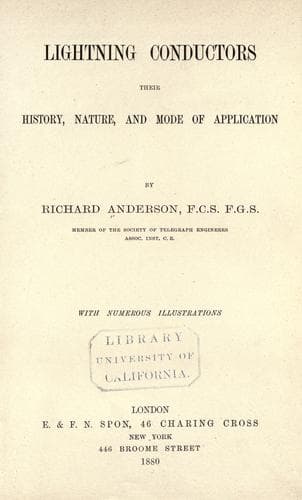
Lightning Conductors: Their History, Nature, and Mode of ApplicationAnderson, Richard, F.C.S.
History
Lightning Conductors: Their History, Nature, and Mode of Application
Anderson, Richard, F.C.S.
Lightning conductors
Like most other inventions and discoveries, that of the lightning
conductor was destined not to be without its early martyrs. Among the
many searchers in the science of electricity on the continent of Europe
who had eagerly seized the ideas of Benjamin Franklin, and entered
enthusiastically upon the experiments recommended by him, was Professor
George Wilhelm Richmann, of St. Petersburg. He had conceived some
theories of his own regarding electrical discharges, and constructed
for experimental purposes an apparatus which he called the ‘gnomon,’
one of the uses of which was to measure the comparative strength of
electrical currents. The instrument consisted of a tube of metal,
terminating in a small glass vessel, into which, for some unknown
reason, he put a quantity of brass filings. Attached to the tube of
metal, at its top, was a chain, so arranged as to be easily attached
or detached from it, and this was fastened to an iron rod going to the
roof, in the form of a lightning conductor, as prescribed by Franklin.
It seems to have been the notion of the professor that he might lead
the electrical current from the clouds down into his ‘gnomon’ bottle,
there to measure its strength; though it is difficult to conceive
how a man acquainted with the manifestations of the mystic force
with which he was experimenting, and knowing its powerful effects,
should not have perceived the extreme danger of thus leading it into a
nonconducting element. However, the enthusiastic man, evidently blind
to all consequences, set out on his course of experiments. A violent
thunderstorm coming over St. Petersburg on August 6, 1753, Professor
Richmann hurried to his ‘gnomon,’ attached the chain to the phial, and
then stood to watch the effect, with not more than a foot and a half
distance between his head and the glass tube. Near him, but further
behind, stood a friend, M. Solokow, who was going to make a drawing
of the electrical apparatus. All on a sudden, there came a terrible
flash of lightning, described as ‘a ball of fire’ by M. Solokow, down
from the skies, falling upon the ‘gnomon’ and springing from thence
upon Professor Richmann, laid the latter dead on the floor, and his
companion senseless.
Public-domain text, read in full here on John Shaqi.
Reviews
Reviews
No reviews yet
Be the first to share your thoughts on this work.
Join the Discussion
Join the discussion
Sign in to leave a comment or review.
Sign InorCreate an account