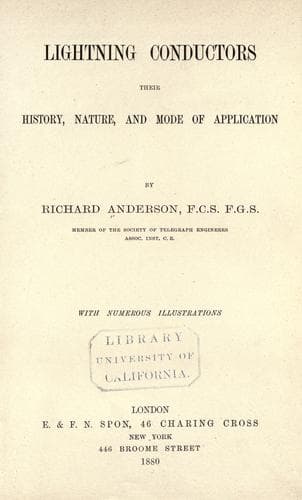
Lightning Conductors: Their History, Nature, and Mode of Application — John Shaqi
Lightning Conductors: Their History, Nature, and Mode of ApplicationAnderson, Richard, F.C.S.
History
Lightning Conductors: Their History, Nature, and Mode of Application
Anderson, Richard, F.C.S.
Lightning conductors
Having improved in various ways the lightning conductor set up
experimentally over his own house, Franklin erected a second one, of
larger dimensions, to protect the residence of one of his friends, Mr.
West, a wealthy merchant of Philadelphia. The apparatus, constructed
entirely under the supervision of Franklin, consisted of an iron rod
half an inch in diameter throughout its length, and ending at the
bottom in a thick iron stake, driven four or five feet into the ground.
The top of the conductor, rising nine feet above the central stack of
chimneys, was formed by a brass wire ten inches in length, tapering off
in a sharp point. Franklin considered the brass wire, which was screwed
and soldered inside the iron rod, a great improvement upon simple iron,
having discovered brass, as well as copper, to be better conductors of
electricity. The result justified his expectations. Not many months
after the lightning conductor had been erected over the mansion of Mr.
West, a thunderstorm more severe than had been experienced for many
years broke over Philadelphia. Vivid flashes of lightning followed each
other incessantly, one of them striking, visible to all beholders, the
house of Mr. West, touching the point of the conductor on the roof,
and appearing again on its base in a thin sheet of flame. Naturally,
Franklin was delighted at this first notable result of his grand
discovery, and lost no time in examining the traces of the lightning
over his conductor. He found that the sharp metal point at the upper
end had been melted, and the small brass wire reduced from ten to seven
and a half inches, with its top very blunt. The thinnest part of the
wire, he saw at once, had disappeared in smoke, while the portion below
it, a little thicker, had simply been liquefied, sinking down while in
a fluid state, and forming a rough irregular cap, lower on one side
than on the other. This was a highly interesting test, showing that
the wire on the summit of the conductor must not be made too thin, so
as to be liable to be burnt. But still more interesting to Franklin
was the investigation of the report, confirmed on all sides, that a
sheet of flame had been seen at the base of the conductor, where it
was connected with the earth. He at once suspected that the earth at
the point, and down to the end of the metal rod, had been very dry,
and such indeed was the case. Hence he arrived at the conclusion that
all conductors should go deep enough into the earth to find sufficient
moisture quickly to dissipate the electric fluid. All subsequent
experience, down to the present day, has proved that the inference of
the practical philosopher of Philadelphia was as sound in this respect
as in the rest of his ever clear and lucid judgments.
Public-domain text, read in full here on John Shaqi.
Reviews
Reviews
No reviews yet
Be the first to share your thoughts on this work.
Join the Discussion
Join the discussion
Sign in to leave a comment or review.
Sign InorCreate an account