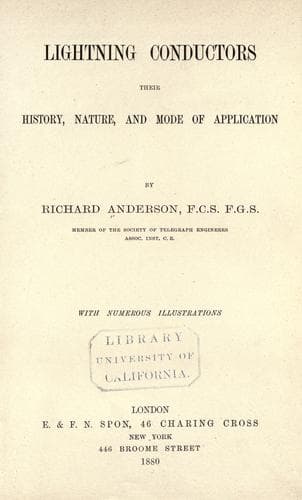
Lightning Conductors: Their History, Nature, and Mode of ApplicationAnderson, Richard, F.C.S.
History
Lightning Conductors: Their History, Nature, and Mode of Application
Anderson, Richard, F.C.S.
Lightning conductors
In singular contrast with the burst of applause with which the whole
scientific world of Europe received the great discovery of Benjamin
Franklin, was the extreme slowness of the actual introduction
into Europe of lightning conductors. The opposition they met
with in Franklin’s own country was trifling to that which they
encountered in the principal states of Europe, more particularly
in England and France. It was natural, perhaps, that the lower
classes--ultra-conservative, through the mere effect of ignorance, in
every country in the world--should see danger in the setting-up of
iron rods which, as they were told, drew lightning from the skies;
and it was, perhaps, equally natural that religious fanatics should
regard them with extreme suspicion, as removing one of their imagined
instruments of heaven for punishing sinful mortals. Both these classes,
the untaught multitude and the bigoted zealots, opposed in Europe,
as they did in America, the establishment of lightning conductors;
but to the strength of these parties was unexpectedly added a third
in a not numerous but powerful section of learned literary men. They
were chiefly French, but had many adherents in England, as well as in
Germany, the _savants_ of both countries looking then upon France as
the seat of all science, and indeed human knowledge.
The opposition raised against lightning conductors in France was
entirely personal, its origin being due to the wounded vanity of a
very estimable but likewise a very weak man, the already mentioned
Abbé Nollet. Born in 1700, the Abbé had very early in life gained
renown for his scientific researches, and after a while devoted much
of his time to electrical experiments, in conjunction with two other
celebrated men, Dufay and De Réaumur. When the report of Franklin’s
discoveries arrived in Europe, the Abbé Nollet was generally looked
upon as the greatest of living ‘electricians,’ and the general homage
paid to him having roused his self-esteem to an inordinate degree, he
got fiercely irritated that another man, a previously quite unknown
person, in a distant land, should have dared to snatch from him his
scientific laurels. Accordingly, he used all his influence among the
public, in the scientific world, and at the French court, where he held
a high position as tutor of the King’s children, not only to depreciate
Franklin’s lightning conductors, but to set them down as something like
an imposture. In various treatises and articles published in learned
papers, Abbé Nollet sought to prove that the person called Benjamin
Franklin--in whose very existence he formerly refused to believe, but
which he now grudgingly acknowledged--was an individual unacquainted
even with the first principles of the science of electricity, and that
his proposal for protecting houses against lightning was so absurd
as not to be worth engaging the attention of any thinking man. More
than this, he argued that the proposed lightning conductors were not
Public-domain text, read in full here on John Shaqi.
Reviews
Reviews
No reviews yet
Be the first to share your thoughts on this work.
Join the Discussion
Join the discussion
Sign in to leave a comment or review.
Sign InorCreate an account