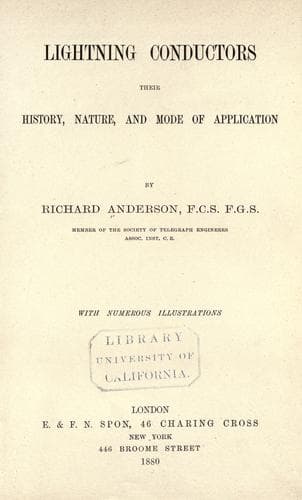
Lightning Conductors: Their History, Nature, and Mode of ApplicationAnderson, Richard, F.C.S.
History
Lightning Conductors: Their History, Nature, and Mode of Application
Anderson, Richard, F.C.S.
Lightning conductors
only inefficacious, but positively dangerous. By thus joining in the
vulgar cry of lightning being, so to speak, sucked from the clouds
by Franklin’s conductors, the learned Abbé had the satisfaction of
retarding their introduction in his own, as well as other European
countries, for a number of years.
In France itself the thus awakened resistance to the setting-up of
lightning conductors was strikingly shown by an incident which occurred
at the town of St. Omer, not far from Calais. A manufacturer settled
here, who had been in America, and there learnt to appreciate the
usefulness of Franklin’s lightning conductors, had one made for his
own house, and quietly fixed it to wall and roof. But the populace no
sooner heard of it when there arose a public disturbance, and the iron
rod was torn down by force. So far from repressing the rioters, the
municipality of St. Omer, acting under priestly influence, forbade the
manufacturer to erect another lightning conductor, on the ground that
it was ‘against law and religion.’ Thereupon the bold manufacturer, a
man of English descent, to try his right, appealed to the tribunals,
and the judges at last, after protracted pleadings, not being able to
discover any statutes against the fastening of metal rods to buildings,
declared that the thing might be done, but with precautions. The lawyer
who pleaded the case of the lightning conductors before the French
tribunals at this momentous period was a very young man, quite unknown
to fame at the time, but destined for a superabundance of it. His name
was Robespierre.
Public-domain text, read in full here on John Shaqi.
Reviews
Reviews
No reviews yet
Be the first to share your thoughts on this work.
Join the Discussion
Join the discussion
Sign in to leave a comment or review.
Sign InorCreate an account